Influence of Indian Cinema and Theatre on Society

Influence of Indian Cinema and Theatre on Society

The earliest form of classical theatre of India was the Sanskrit theatre which came into existence only after the development of Greek and Roman theatres in the west. (Despite its name, Sanskrit theatre was not exclusively in Sanskrit languageOther Indic languages collectively called as Prakrit were also used in addition to Sanskrit).

Indian theatre has an unbroken history of over two thousand years. Almost contemporaneous with Aristotle’s poetics, ancient India produced an encyclopaedic manual on theatre called Natyashastra ascribed to Bharata, which became the basis Indian performances genres for centuries to come. This means that there already a rich tradition of performance practice long before such a work appeared. The aesthetic theory of rasa briefly but cogently expounded in NS influenced Indian aesthetic theory and practice for more than a millennium.

The first millennium was also characterized by the great harvest of Sanskrit drama by pre-eminent play-wrights like Bhasa, Kalidasa, Shudraka, Vishakadatta, Bhavabhuti and Harsha. This body of works compares in its range and power with the dramatic output of other rich theatre traditions of the world ancient Greek theatre and Elizabethan theatre. The glory of ancient Sanskrit drama ended with the first millennium. The medieval period witnessed the emergence of regional language literatures in which did not produce dramatic works comparable to ancient classics. However, folk and ritualistic theatres flourished throughout this period. Some innovations happened in religious drama, thanks to socio-religious reform Bhakti Movements, which engulfed the subcontinent during the medieval era.

Against the background of this rich tradition, Indian drama was reborn during British colonial interregnum in 18th and 19th centuries. The impetus came from two sources: the rich heritage of Indian drama and the exposure to Western dramatic classics through English. Translations started appearing simultaneously of Sanskrit classics and Western classics, particularly Shakespeare. Till now drama had not developed as a major literary genre in Indian languages. Drama now began to flourish as a cherished literary genre alongside the modern genre of fiction, also a response to Western influence.

There was corresponding unprecedented development in theatre: the rise of urban entertainment theatre. This arose in order to provide entertainment to the increasing population of big cities consequent upon industrialization. The new urban theatre is popularly known as Parsi theatre. This genre was an interesting mixture of Western Naturalistic drama, opera and several local elements. Spectacle based on huge settings and colourful backdrops was an essential part of it. The stage was normally divided into front and back for the staging of main and subsidiary action. Music was its life-breath. The actors of this theatre were also great singers. The acting became naturalistic and melodramatic in contrast to the stylized techniques of traditional Indian theatre. Parsi theatre productions chose their story-lines from diverse sources: popular mythological, folklore and contemporary life.

There were also adaptations of Western classics like Shakespeare and Lessing. Unlike traditional folk and tribal theatre Parsi theatre was acted out in interior spaces, now called proscenium theatre. Geared to amuse urban middle and working classes this theatre produces a pot pouri of melodrama, humour, romance and social criticism. Having developed in newly emerging big cities like Kolkata, Delhi, Mubai and Chennai form late 19th century, this form of professional theatre performed by professional groups, sometimes travelling, was the only source of mass entertainment before the emergence of cinema. With their emphasis on music, spectacle and melodrama, their productions became the paradigms for Indian cinema. Except in some states like Maharashtra and Assam, entertainment theatre was gradually supplanted by popular cinema by 1970’s.

Though entertainment theatre thrilled masses, it elicited criticism from sensitive sections of modern Indian population, particularly from educated people. This paved the way for literary drama and amateur theatre. Literary drama was the output of great Indian language writers in different parts of India. The most famous of such playwrights was Rabindranath Tagore, who enriched the genre of drama as much as he enriched poetry and fiction. Disillusioned with contemporary popular drama, Tagore created his own drama and theatre with no precedents in East or West, though borrowing elements from both. Some of his plays like Chitrangada, a musical play and Post-office, became internationally well-known and performed in Europe and North America. His plays, which are the classics of world drama, were orchestrations of rich poetry, symbolism, socio-political criticism and cosmic vision. They were also prophetic in his understanding of experience as they critique excesses of technological development as in plays like Muktadhara and Roktokoribi.

An archetypal work of socialist realism is the Telugu classic Kanyashulkam by Vireshalingam Pantulu. This play is an atack on dowry-system that part of Indian marriage. It became immensely influential because of its reformatory appeal. Another prolific author who wrote plays on social evils like caste system, exploitation of women, religious hypocrisy was the Kannada playwright Adya Rangachary (Sriranga). The elements of social criticism were also present in entertainment and literary theatre though mixed with several other elements.

Socialist realism was associated with IPTA (Indian Political Theatre Association) experiments. IPTA was a group of artists belonging to Leftist intelligentsia. Though its manifestations were varied from region to region they were all wedded to the view of theatre as a means for social change. The regions where this movement was strongest were Uttar Pradesh, Delhi, Maharashtra, Bengal, Punjab, Andhra Pradesh and Kerala. The North Indian versions of IPTA were mostly influenced by socialist realist works of Howard Fast and Maxim Gorki. Bhisham Sahani is an example of this kind of drama. In the South, efforts were made to reconcile social message with traditional forms. The most renowned of such plays is a Malyalam work, Ningal Endai Communist Akki (You Made Me a Communist) by Toppil Bhasi. The legendary production of this musical play is said to have paved the way for the first ever elected Communist government in Kerala.

Soon after India’s Independence in 1947, the theatre scene began to change radically. The impact of IPTA began to wane. Entertainment theatre received a set-back due to the challenge of the more popular genre of cinema. Amateur theatre continued to flourish in big cities like Delhi, Mumbai, Kolkata and Bangalore.  In Kolkata two important theatre stalwarts emerged: Utpal Dutt and Shambhu Mitra.The former made significant contributions to political theatre after the waning of IPTA. A playwright, director, actor and producer, who had parted ways with IPTA, he did several memorable productions like Teen Talwar and Surya Shikari which made a deep impression. The influence of Socialist Realism was clearly discernible in his works. His another important contribution was the reworking of the popular folk theatre Jatra and making it a vehicle of communicating contemporary political messages. Shambhu Mitra, on the other hand, focused on finetuning the aesthetic form of Theatre. His production of Tagore’s Rakta Korabi was a widely acclaimed work.

Cinema’s impact on Indian society

Since its beginning with the film ‘Raja Harish Chandra’ (1913), the cinema has remained the most powerful media for mass communication in India.

Since its beginning with the film ‘Raja Harish Chandra’ (1913), the cinema has remained the most powerful media for mass communication in India. Cinema has the ability to combine entertainment with communication of ideas. It has the potential appeal for its audience. It certainly leaves other media far behind in making such an appeal. As in literature, cinema ahs produced much which touches the innermost layers of the man. It mirrors the episodes in such a manner that leaves an impact on the coming generations. Cinema presents an image of the society in which it is born and the hopes, aspirations, frustration and contradictions present in any given social order.

There are variable views about the effects of cinema. Producers and financiers consider it as a tempting and lucrative business. For actors and actresses, it is a means to earn money and popularity among masses. The director, story-writer, song-writer and cinematographer take it as an art work. To some, it is an audio-visual translation of literatures and has its own message. As for government, it is a potential source of revenue and employment. For majority of cinema-goers, it is nothing but a cheap and interesting form of entertainment and pastime. Whatever may be the reason, cinema has occupied a major share of market for its cine lovers.

In the present era, cinema is getting replaced by small screen productions. Televised serials and programmes are replacing craze. They advertise and earn revenue for industry. Thus films telecast has become a source of further income for the industry and trade.

Man has instincts, different thoughts flow which leave an effect on the minds. The person laughs with the films and tears with them. Scenes of ‘Shaheed Bhagat Singh’, a film by Raj Kumar Santoshi and Manoj Goswami makes people national-minded and sentimentally involved in the film show. The fim dialogues are occupying places in our real life. Dialogues of Mugle Azam found place in the normal interaction of people for a long time. People talked and walked like Prithvi Raj, the great king Akbar. In the same way, plays by Agha Hashat and Devdas by Sharat Chandra left a deep impact on the masses. In the same way, film ‘Sholey’ created an imending effect on so many.

It is always good and well groomed to see good subjects on cinema. They have a very positive and long-lasting effect on the minds whereas cheap and shabby movies affect the tender minds of audience very badly. There is general feeling that present day crimes are all due to effects of cinema. Besides open and demonstrative subjects throw tarnished messages. They spoil our culture, and society. Cinema and TV badly affect the health of the youngsters. They neglect studies and physical games to spend more time on this entertainment. School-going children and society children fail to make use of good impacts and are influenced by the bad part of the programmes on the air.
TRENDS IN NUCLEAR POLICY, NPT AND CTBT


Nuclear policy of india

  • Important points of india’s nuclear policy are as follows:
  • Building and maintaining a credible minimum deterrent.
  • nuclear weapons will only be used in retaliation against a nuclear attack on Indian Territory or on Indian forces elsewhere.
  • Nuclear retaliation to a first strike will be massive and designed to inflict unacceptable damage.
  • Nuclear retaliatory attack can be authorized by a certain political leadership only through NCA ( nuclear command authority) .
  • No-use of nuclear weapons against non-nuclear weapon state.
  • In the event of a major attack against India or Indian forces anywhere by biological or chemical weapons. India will retain the option of retaliating with nuclear weapons.
  • Continuance of strict control on export of nuclear and missile related materials and technology, participation in the fissile material cut off treaty negotiations and continued observance of the moratorium on nuclear tests.
  • Continued commitment to the goal of a nuclear-free world through global verifiable and no discriminatory nuclear disarmament.


India’s “minimum credible nuclear deterrence” doctrine and “no first use” policy are based on the concept of deterrence by denial, rather than deterrence by punishment. Should deterrence ever break down, India will have to pay an enormous price for a nuclear first strike by an adversary before launching massive punitive retaliation. Nuclear doctrine has to be ultimately tested in the crucible of operational reality. Across the entire spectrum of conventional conflict, the first use of nuclear weapons by India does not make sound strategic sense. The real distinguishing feature of India’s nuclear doctrine is that it is anchored in India’s continued commitment to global, verifiable and non-discriminating nuclear disarmament.

The concept of deterrence by denial, rather than deterrence by punishment, is central to Indian strategic thinking. However, by voluntarily renouncing its sovereign right of the first use of nuclear weapons to defeat nuclear threats and to prevent nuclear blackmail, India has made an immense strategic sacrifice and imposed a heavy burden upon itself. The government and key decision-makers recognise that should deterrence ever break down, India will have to pay an enormous price for a nuclear first strike by an adversary before retaliating in kind. Hundreds of thousands of Indian lives will be lost and more than one city may be turned into rubble. Hence, India’s no first use doctrine demands a robust, infallible and potentially insuperable nuclear deterrent capability to ensure that India never has to suffer a nuclear strike.

The government also affirmed that India’s nuclear threat perceptions were not country specific. On December 15, 1998, Prime Minister Vajpayee spelt out the principal elements of India’s nuclear policy in a statement in Parliament. India’s resolve to preserve its nuclear independence, minimum nuclear deterrence, no first use, non-use of nuclear weapons against non-nuclear powers, and a firm commitment to the elimination of nuclear weapons. The Prime Minister also reiterated India’s willingness to sign the CTBT and re-stated India’s readiness to work towards the successful conclusion of the Fissile Materials Cut-off Treaty (FMCT). At the Non-Aligned Summit in Durban in 1998, the Movement accepted India’s proposal for an international conference to arrive at an agreement on a phased programme for the complete elimination of all nuclear weapons. At the Millennium Summit of the United Nations in September 2000, the Indian Prime Minister asserted that India’s policy is based on “responsibility and restraint” and that India would continue to press for universal, verifiable nuclear disarmament with undiminished commitment, even while safeguarding “our strategic space and autonomy in decision-making. International peace cannot be divorced from the need for equal and legitimate security for all.

New trends in india’s nuclear policy

More than a decade since the nuclear doctrine was unveiled by the government, several organizations and individuals have commented on it. Some of them have been critical of the no-first-use doctrine. Experts says no first use is not the least credible, because it requires India to first absorb a nuclear attack before responding to enemy’s attack.

In 2011, BJP leader Jaswant Singh had asked for abandonment of the no first use policy but the UPA government decided to maintain status quo. Former prime minister Manmohan Singh, while speaking at the Institute for Defence Studies and Analyses, New Delhi, on April 2, 2014, called for a global “no-first-use” norm. He said, “States possessing nuclear weapons must quickly move to the establishment of a global no-first-use norm. This was followed by the Bharatiya Janata Party (BJP) promising in its election manifesto to “study in detail India’s nuclear doctrine, and revise and update it, to make it relevant to challenges of current times…” and to “maintain a credible minimum deterrent that is in tune with changing geostrategic realities.

Criticism of the nuclear doctrine has mainly been centered on a few key issues: No first use may result in unacceptably high initial casualties and damage to Indian population, cities, and infrastructure, massive retaliation is not credible, especially against a tactical nuclear strike on Indian forces on the adversary’s own territory; nuclear retaliation for chemical or biological attack would be illogical, especially as the attack may be by nonstate actors; and it would be difficult to determine what constitutes a “major” chemical or biological strike.

Most recently, Lt. Gen. B.S. Nagal (Ret.), former commander in chief, Strategic Forces Command, and later head of the Strategic Planning Staff at the National Security Council Secretariat, has questioned the efficacy of the NFU doctrine. According to him, “It is time to review our policy of no first use. The choices are ambiguity or first use.” He gives six main reasons for seeking a change: no first use implies acceptance of large-scale destruction in a first strike, the Indian public is not in sync with the government’s no first use policy and the nation is not psychologically prepared, it would be morally wrong, the leadership has no right to place the population in peril. No first use allows the adversary’s nuclear forces to escape punishment as retaliatory strikes will have to be counter value in nature, an elaborate and costly ballistic missile defense system would be required to defend against a first strike; and escalation control is not possible once nuclear exchanges begin.

Recently india’s Defence minister Manohar parrikar questioned no first use policy . Speaking in New Delhi at the launch of Brigadier (retd) Gurmeet Kanwal’s book The New Arthashastra, Parrikar said: “Why a lot of people say that India has No First Use policy. Why should I bind myself . I should say I am a responsible nuclear power and I will not use it irresponsibly. This is my thinking. However later he clarified this was his individual thinking.

There has again been speculation recently about India’s nuclear doctrine and the value of its no first-use-posture. The reason for the kerfuffle this time are a couple of sentences in former national security advisor Shivshankar Menon’s book, Choices: Inside the Making of Indian Foreign Policy. Menon writes “There is a potential grey area as to when India would use nuclear weapons first against another NWS (nuclear weapons state). Circumstances are conceivable in which India might find it useful to strike first, for instance, against an NWS that had declared it would certainly use its weapons, and if India were certain that adversary’s launch was imminent.

​​The core principles of the Indian nuclear policy have remained unchanged, as has its commitment to a world free from nuclear weapons. Gradually, India has been integrating itself with the non-proliferation regime. Meanwhile, India has joined a number of non-proliferation mechanisms of which it was skeptical before. India is now formally the 35th member of the Missile Technology Control Regime (MTCR) — an association of countries that share the goals of non-proliferation of delivery systems for nuclear weapons. India is also actively seeking membership of the Nuclear Suppliers Group (NSG). The twenty first century is watching remarkable changes in India’s nuclear policy but for now core of India’s nuclear policy is still the same.

NPT ( NON-PROLIFERATION TREATY)

The NPT is a landmark international treaty whose objective is to prevent the spread of nuclear weapons and weapons technology, to promote cooperation in the peaceful uses of nuclear energy and to further the goal of achieving nuclear disarmament and general and complete disarmament. The Treaty represents the only binding commitment in a multilateral treaty to the goal of disarmament by the nuclear-weapon States. Opened for signature in 1968, the Treaty entered into force in 1970. On 11 May 1995, the Treaty was extended indefinitely.  A total of 191 States have joined the Treaty, including the five nuclear-weapon States. More countries have ratified the NPT than any other arms limitation and disarmament agreement, a testament to the Treaty’s significance.

Silent provisions of non-proliferation treaty are as follows:

Each nuclear weapon state party to this treaty undertakes not to transfer to any recipient whatsoever, nuclear weapons or other nuclear explosive devices or control over such weapons or explosive devices directly or indirectly; and not in any way to assist, encourage or induce any non-nuclear weapon state to manufacture or otherwise acquire nuclear weapons or other nuclear explosive devices.

Each non-nuclear weapon state party to this treaty undertakes not to receive as transfer from any power whatsoever of nuclear weapons or other nuclear explosive devices or of control over such weapons, explosives, directly or indirectly; not to manufacture or otherwise acquire nuclear weapons or other nuclear explosive devices; and not to seek or receive any assistance in the manufacture of nuclear weapons or other nuclear explosive devices.

All the Parties to the Treaty undertake to facilitate, and have the right to participate in, the fullest possible exchange of equipment, materials and scientific and technological information for the peaceful uses of nuclear energy. Parties to the Treaty in a position to do so shall also co-operate in contributing alone or together with other States or international organizations to the further development of the applications of nuclear energy for peaceful purposes, especially in the territories of non-nuclear-weapon States Party to the Treaty, with due consideration for the needs of the developing areas of the world.

This treaty shall enter into force after its ratification by all nuclear-weapons states signatory to this treaty and by other states signatory to this treaty, after the deposit of their instrument of ratification. For the purpose of this treaty, a nuclear weapons state is one which has manufactured and exploded a nuclear weapon or other nuclear explosive device prior to 1st January, 1967.

Each party shall, in exercising its national sovereignty, have the right to withdraw from the treaty if it decided that extra-ordinary events, related to the subject-matter of this treaty, have jeopardized the supreme interests of its country. It shall give notice of such withdrawal to all other parties to the treaty and the United Nations Security Council three months in advance. Such a notice shall include a statement of the extraordinary events it regards as having jeopardized its supreme interests.

India and criticism of NPT

  • India thinks NPT is discriminatory. There are two types of members in the NPT – Nuclear Weapons State and Non-Nuclear Weapons State. Only five countries (including China) who had fired a nuclear device before 1970 were given the status of Nuclear Weapons State. Any other nation who wished to sign the NPT, had to do so as a Non-Nuclear Weapons State. India exploded its first nuclear device in 1974 – this implies that the only option by which India could sign the NPT is being a Non-Nuclear Weapons State.
  • India needs a minimum nuclear deterrant. If India signs the NPT as a Non-Nuclear Weapons State, India cannot even keep a minimal nuclear deterrant. In the light of the wars waged with neighbours China and Pakistan, this option seems suicidal, given China and Pakistan themselves have nuclear weapons. Therefore even popular political support, across the political spectrum, has been towards nuclear weapons program, rather than signing the NPT.
  • NPT unduly tried to legitimize the power gap between nuclear and non-clear nations.
  • It did not provide for either disarmament or arms control in international relations.
  • It failed to check the N-programmes of France and China which, in violation of the Moscow Partial Test Ban Treaty, continued the policy of conducting nuclear tests.

On the basis of these arguments, critics asserted that NPT failed to solve the problem of nuclear weapons in international relations. It failed to provide any scheme or plan for nuclear disarmament or arms control. Its first review was done in 1975, the second in 1980 and the third in October 1985, but these three reviews failed to secure or improve the realization of the provisions of this treaty

India’s former External Affairs Minister Pranab Mukherjee said during a visit to Tokyo in 2007: “If India did not sign the NPT, it is not because of its lack of commitment for non-proliferation, but because we consider NPT as a flawed treaty and it did not recognize the need for universal, non-discriminatory verification and treatment.”

Comprehensive nuclear test ban treaty ( CTBT )

The Comprehensive Nuclear-Test-Ban Treaty (CTBT) is the Treaty banning all nuclear explosions – everywhere, by everyone. The Treaty was negotiated at the Conference on Disarmament in Geneva and adopted by the United Nations General Assembly.

The Treaty was adopted by the United Nations General Assembly on 10 September 1996. It opened for signature in New York on 24 September 1996, when it was signed by 71 States, including five of the eight then nuclear-capable states. As of October 2016, 166 states have ratified the CTBT and another 17 states have signed but not ratified it.

The treaty will enter into force 180 days after the 44 states listed in Annex 2 of the treaty have ratified it. These “Annex 2 states” are states that participated in the CTBT’s negotiations between 1994 and 1996 and possessed nuclear power reactors or research reactors at that time. As of 2016, eight Annex 2 states have not ratified the treaty: ChinaEgyptIranIsrael and the United States have signed but not ratified the Treaty; IndiaNorth Korea and Pakistan have not signed it.

Silent features of CTBT are as follows:

  • The Treaty banned every kind of nuclear weapons test or nuclear explosion.
  • An international monitoring system was to be set up for checking violations of CTBT.
  • Any underground, atmospheric or underwater explosions more powerful than the equivalent of 1,000 tones of conventional explosive was to be detected by a network of 20 stations.
  • Further, based on information collected by the international monitoring system or through surveillance by individual countries (but not through spying activities), any country could request an inspection to see whether an explosion had been carried out or not. A request for an inspection was to require 30 votes in the 51-member Executive Council.

India and criticism of CTBT

In May 1998, India and Pakistan conducted a series of nuclear tests. Not only did this jolt the nonproliferation regime, the tests also broke a global moratorium on nuclear testing that had been in existence since July 1996, a moratorium that had been reinforced by the adoption of the Comprehensive Test Ban Treaty (CTBT) in September 1996. For India, the tests were the culmination of a major turnaround in policy. When the negotiations that led to the CTBT commenced in 1994, India in fact displayed enthusiasm for the treaty. However, by the time negotiations concluded in 1996, India had emerged as the treaty’s strongest opponent. On June 20, 1996, India declared its unwillingness to sign the CTBT, stating that because the treaty “is not conceived as a measure towards universal nuclear disarmament. India cannot subscribe to it in its present form.”2 On September 10, 1996, when the CTBT was adopted at the United Nations, India stated that it would “never sign this unequal Treaty, not now, nor later.

India’s interest in a test ban was first outlined in an April 1954 speech to the Indian Parliament, when Prime Minister Jawaharlal Nehru called for an end to nuclear testing as a stepping stone towards nuclear disarmament. Nehru stated that, “Pending progress towards some solution, full or partial, in respect of the prohibition and elimination of these weapons of mass destruction, the Government of India would consider, some sort of what may be called a standstill agreement” on ending nuclear testing. In the following decades, New Delhi remained enthusiastic about disarmament. But it simultaneously opposed the NPT and CTBT for ideological and security reasons. India’s rationale behind its stand are as follows:

India felt that the CTBT was inadequate in terms of securing disarmament commitments from the nuclear weapon states under declared deadlines. It saw this as a discriminatory replication of the imbalance inherent in the Nuclear Non-Proliferation Treaty (NPT) regime, in which nuclear weapon states are weakly obligated to disarm and non-nuclear weapon states are strongly obligated to remain non-nuclear. The lack of commitments by the nuclear weapon states to eliminate their nuclear weapons under a declared time frame also compelled India to oppose Article XIV of the NPT, which stipulates the CTBT’s entry into force after 44 “Annex 2″ countries sign and ratify it.

India’s argument is that his  strategic program needs to be safeguarded until a credible disarmament process begins. On a sublime note, some in India will contend that the CTBT remains improvident until the nuclear weapon states commit to a time-bound disarmament framework. Yet to get the ball rolling on eliminating nuclear weapons, India passes the responsibility to the permanent five members of the U.N. Security Council (the five nuclear weapon states recognized under the NPT). India cannot accept any restraints on its capability if other countries remain unwilling to accept the obligation to eliminate their nuclear weapons.”

Fundamental Rights and Duties

The Indian constitution originally provided 7 categories of fundamental rights. But one fundamental right, that to property was removed from the list of fundamental rights by 44th amendment. Right to property now is an ordinary legal right. Thus there are now 6 categories of fundamental rights. These are:

 (1) Right to equality (Arts. 14-18).

In this category there are five rights

  • Equality Before Law:- Equality before law is well defined under the Article 14 of the Constitution which ensures that every citizen shall be likewise protected by the laws of the country. It means that the State will not distinguish any of the Indian citizens on the basis of their gender, caste, creed, religion or even the place of birth. The state cannot refuse equality before the law and equal defense of the law to any person within the territory of India. In other words, this means that no person or groups of people can demand for any special privileges. This right not only applies to the citizens of India but also to all the people within the territory of India. Equality means that equals should be treated equally.
  • Abolition Of Discrimination On Grounds Of Caste, Race, Sex Or Religion:- The right of Social Equality and Equal Access to Public Areas is clearly mentioned under the Article 15 of the Constitution of India stating that no person shall be shown favoritism on the basis of color, caste, creed language, etc. Every person shall have equal admittance to public places like public wells, bathing ghats, museums, temples etc. However, the State has the right to make any special arrangement for women and children or for the development of any socially or educationally backward class or scheduled castes or scheduled tribes. This article applies only to citizens of India.
  • Equality in public employment, Article 16 of the Constitution of India clearly mentions that the State shall treat everyone equally in the matters of employment. No citizen shall be discriminated on the basis of race, caste, religion, creed, descent or place of birth in respect of any employment or office under the State. Every citizen of India can apply for government jobs. However, there are some exceptions to this right. The Parliament may pass a law mentioning that specific jobs can only be filled by candidates who are residing in a particular area. This requirement is mainly for those posts that necessitate the knowledge of the locality and language of the area. Apart from this, the State may also set aside some posts for members of backward classes, scheduled castes or scheduled tribes which are not properly represented in the services under the State to uplift the weaker sections of the society. Also, a law may be passed which may entail that the holder of an office of any religious institution shall also be a person professing that specific religion. Though, this right shall not be granted to the overseas citizens of India as directed by the Citizenship (Amendment) Bill, 2003.
  • Abolition of untouchability, Article 17 of the Constitution of India abolishes the practice of untouchability in India. Practice of untouchability is declared as a crime and anyone doing so is punishable by law. The Untouchability Offences Act of 1955 (and now Protection of Civil Rights Act in 1976) states punishments for not allowing a person to enter a place of worship or from taking water from a well or tank.
  • Abolition of titles. Article 18 of the Constitution of India prohibits the State from granting any titles. Citizens of India are not allowed to accept titles from a foreign State. Titles like Rai Bahadurs and Khan Bahadurs given by the British government have also been abolished. Nevertheless, academic and military distinctions can be conferred upon the citizens of India. The awards of ‘Bharat Ratna’ and ‘Padma Vibhushan’ cannot be used by the beneficiary as a title and is not prohibited by the Constitution of India. From 15 December 1995, the Supreme Court has sustained the validity of such awards

 (2) Rights to freedom.

(Arts. 19-22) these now include six freedoms-

  • Freedoms of speech and expression,
  • Freedom of assembly without arms of association,
  • Freedom of movement,
  • Freedom of residence and
  • Freedom of profession oroccupation.

Each one of these six freedoms is subject to some restrictions. For rights can never be absolute. Individual rights must be reconciled with the interests of the community. It is logical that equal rights for all must mean limited rights for any. Hence, the state may impose ‘reasonable restrictions’ upon the exercise of any of these rights.

Restrictions

Firstly, the state may impose restrictions on the exercise of the right to freedom of speech and expression on eight grounds. These are:

  1. defamation,
  2. contempt of court,
  3. decency or morality,
  4. security of the state,
  5. friendly relations with other states,
  6. incitement of offence and,
  7. sovereignty and
  8. integrity of India.

Secondly, the freedom to assemble is subject to two restrictions. The assembly must be peaceable and the members of assembly must not bear arms. However the Sikhs are allowed to carry ‘Kirpan’ as part of their religious creed. In the U.S.A. right to bear arms is fundamental right. In India, this right is denied in the interest of public order.

Thirdly, the right to form associations or unions does not entitle persons to enter into criminal conspiracy either against individuals, groups or against the state.

Fourthly, the right to move freely or to reside and settle in any part of India, does not cover trespass into homes or restricted areas. State also may restrict this freedom to protect the aboriginal tribes.

Finally, the right to practice any profession or to carry on any occupation, trade or business are also subject to reasonable restrictions. Thus professions or, trade or, business must not be harmful to the interest of the community. The state may also prescribe qualifications for particular profession or, technical occupation. The state may itself carry on trade or business to the exclusion of citizens.

Power of Courts to enforce freedom of citizens of India

Every Indian citizen has the power to move the High Court or the Supreme Court for protecting and securing his personal freedom. The Courts are empowered to issue writs in the nature of habeas corpus. The courts can order the presence of detained or imprisoned person and set him free in case there is no legal justification for his detainment or imprisonment.

Rights to Freedom during National Emergency

The rights to freedom under Article 19 of Indian constitution are suspended during the period of National Emergency declared by the President of India.

Further, during the period when the National emergency is in operation, the President is empowered to suspend the right of citizens to move the Supreme Court for the enforcement of their personal freedom.

Conclusion

Each one of the fundamental freedoms guaranteed by the constitution of India is hedged by many restrictions. They are not absolute. This led to the criticism that Indian freedom is a myth and not reality for what has been given with one hand has been taken away with the other.

This criticism is unfair. For fundamental rights can nowhere be absolute. For logically, one can be absolutely free only when all others are absolute, slaves Individual freedom to be real must be social and hence must be limited.

There is a difference in the scheme of limitations on fundamental rights in the U.S. constitution and in the constitution of India. In the U.S.A. the restrictions are not mentioned in the constitution itself. This is left to judicial interpretations. In India on the other hand, the restrictions are mentioned in the constitution itself. It is not left to the vagaries of judicial interpretation.

On the whole fundamental rights everywhere are restricted or, limited. As Mr. Justice Mukherji observed in A. K. Gopalan vs. State of Madras case” There cannot be any such thing as absolute or uncontrolled liberty wholly freed from restraints.”

These freedoms are however not without limitations.

(3) Rights against exploitation (Arts. 24 and 25)

Include prohibition of traffic in human beings and prohibition of child labour.

(4)  Rights to freedom of religion (Arts. 25-28)

Include  freedom of conscience and freedom of religion. Citizens are free to profess and practice any religion. These provisions make India a secular state.

 (5) Cultural and Educational rights (Arts. 29-30)

Include right to protection of language, script and culture given to the minorities. The minorities are also given the right to establish and administer educational institutions of their own.

(6)   Right to constitutional remedies (Arts. 32-35)

Provides for enforcement of fundamental rights through the judicial process.Dr BR Ambedkar  expressed it to be the heart and soal of Indian constitution.

Thus the constitution contains an elaborate scheme of fundamental rights. But the fundamental rights in India are not absolute. They are hedged by many limitations. Indeed, fundamental rights cannot be absolute anywhere in the world. Countries differ only in their degree of limitations on fundamental rights.

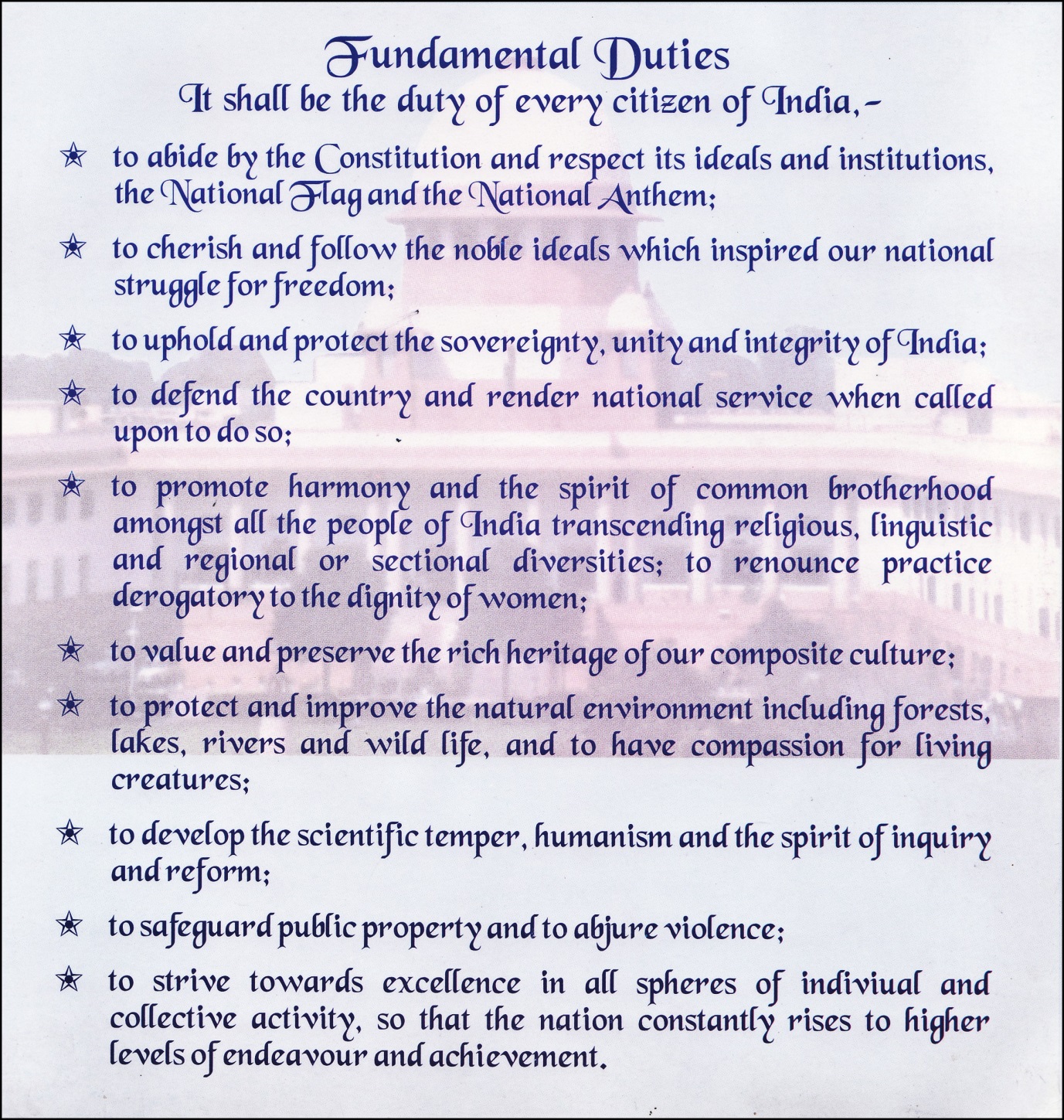
Part IV-A was added by the 42nd Amendment Act, 1976. It encompasses Part IV, Article 51A enu­merating Ten Fundamental Duties of the Citizens of India.

There is no provision in the Constitution for direct enforcement of any of these Duties nor for any sanction to prevent their violation.But it may be expected that in determining the Consti­tutionality of any law, if a Court finds that it seeks to give effect to any of these duties, it may consider such law to ‘be reasonable’ in relation to Article 14 or 19, and thus save such law from unconstitutionality.

Revolutionary Terrorism and Bhagat Singh

  • Revolutionary young men did not try to generate a mass revolution. Instead they followed the strategy of assassinating unpopular officials
  • 1904: VD Savarkar organized Abhinav Bharat
  • Newspapers like The Sandhya and Yugaantar in Bengal and the Kal in Maharashtra advocated revolutionary ideology
  • Kingsford Incident: In 1908, Khudiram Bose and Prafulla Chaki threw bomb at a carriage they believed was carrying Kingsford, the unpopular judge of Muzaffarpur.
  • Anushilan Samiti threw a bomb at the Viceroy Lord Hardinge
  • Centres abroad
    • In London: led by VD Savarkar, Shyamaji Krishnavarma and Har Dayal
    • In Europe: Madam Cama and Ajit Singh
  • They gradually petered out. It did not have any base among the people
  • The sudden suspension of the non-cooperation movement led many young people to question the very basis strategy of non-violence and began to look for alternatives.
  • All the major new revolutionary leaders had been enthusiastic participants in the non-violent non-cooperation movement.
  • Two separate strands of revolutionary terrorism developed – one in Punjab, UP and Bihar and the other in Bengal.
  • Ramprasad Bismil, Jogesh Chatterjea and Sachindranath Sanyal met in Kanpur in October 1924 and founded the Hindustan Republican Association to organize armed revolution.
  • In order to carry out their activities the HRA required funding. The most important action of the HRA was the Kakori Robbery.
  • On August 9, 1925, ten men held up the 8-Down train from Shahjahanpur to Lucknow at Kakori and looted its official railway cash.
  • The government arrested a large number of young men and tried them in the Kakori Conspiracy Case.
  • Ashfaqulla Khan, Ramprasadn Bismil, Roshan Singh and Rajendra Lahiri were hanged, four others were sent to Andaman while seventeen others were sentenced to long term imprisonment.
  • New revolutionaries joined the HRA. They met at Ferozshah Kotla Ground at Delhi on 9 and 10 September 1928, created a new collective leadership, adopted socialism as their official goal and changed the name of the party to the Hindustan Socialist Republican Association.
  • Lala Lajpat Rai dies in a lathi-charge when he was laeding an anti-Simon Commission demonstration at Lahore on 30 October 1928.
  •  On 17 December 1928, Bhagat Singh, Azad and Rajguru assassinated, at Lahore, Saunders, a police official involved in the lathi-charge on Lala Lajpat Rai.
  • In order to let the people know about HSRA’s changed objectives Bhagat Singh and BK Dutt were asked to throw a bomb in the Central Legislative Assembly on 8 April 1929 against the passage of the Public Safety Bill and the Trade Disputes Bill.
  • He aim was not to kill but to let people know of their objectives through the leaflet they threw.
  • They were later arrested and tried.
  • The country was also stirred by the hunger strike the revolutionaries took as a protest against the horrible conditions in jails.
  • On 13th September, the 64th day of the epic fast, Jatin Das died.
  • Bhagat Singh, Sukhdev and Rajguru were sentenced to be hanged. He sentence was carried out on 23 March, 1931.
  • Bhagat Singh was fully secular.
    • The Punjab Naujawan Bharat Sabha organized by him acted on secular lines.
  • In Bengal, after the death of C R Das, the Congress leadership in Bengal got divided into two wings: one led by S C Bose and the other by J M Sengupta. The Yugantar group joined forces with the first while the Anushilan with the second.
  • Surya Sen had actively participated in the non-cooperation movement. He gathered around him a large band of revolutionary youth including Anant Singh, Ganesh Ghosh and Lokenath Baul.
  • Chittagong Armoury Raid


Solanki of Gujrat

Solanki of Gujrat

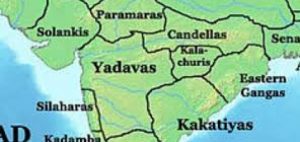
The Solanki dynasty ruled parts of what are now Gujarat and Kathiawar in India between 950-1300 CE. The kings of the dynasty used the self-designation Chaulukya, and are also known as the Chalukyas of Gujarat or as the Solanki Rajputs. The dynasty ended when Alauddin Khalji conquered Gujarat. Gujarat was a major centre of Indian Ocean trade, and their capital at Anhilwara (modern Patan, Gujarat) was one of the largest cities in India, with population estimated at 100,000 in 1000 CE. In 1026, the temple complex of Somnath in Gujarat was destroyed by Mahmud of Ghazni. After 1243, the Solankis lost control of Gujarat to their feudatories, of whom the Vaghela dynasty of Dholka came to dominate. After 1292, the Vaghelas became tributaries of the Seuna (Yadava) dynasty of Devagiri in the Deccan Plateau.

The Solankis were usually referred to as the “Chalukyas of Gujarat” by their contemporaries. The vast majority of their own records describe them as “Chaulukya”, which is thought to be a variant of “Chalukya”. There are several other dynasties with this name: the Chalukyas of Badami, the Chalukyas of Kalyani, the Chalukyas of Vengi and the Chalukyas of Lata. The various dynasties using this name are sometimes thought to be branches of the same family, but the relationship between all of them is not certain. Unlike the Chalukyas of Kalyani and Vengi, the Solankis never claimed a shared descent or any other association with the original Chalukya dynasty — the Chalukyas of Badami. Moreover, they never used the term “Chalukya” to describe themselves, instead using its variant “Chaulukya”.

However, the Solankis did share a myth of origin with the Chalukyas of Kalyani and Vengi. According to this legend, the progenitor of the dynasty was created by Brahma. The version of the legend mentioned in the Vadnagar prashasti inscription of Kumarapala is as follows: the deities once asked the creator god Brahma to protect them from the danavas (demons). Brahma then created a hero from his chuluka (pot or folded palm), which was filled with Ganges water. This hero was named Chulukya, and became the progenitor of the dynasty. A variation of this legend is mentioned by Abhayatilaka Gani in his commentary on Hemachandra’s Dvyashraya-Kavya. According to this version, Brahma produced the hero to support the earth, after his other creations disappointed him. These stories are of no historical value, as it was customary for contemporary royal houses to claim mythical and heroic origins. The Kumarapala-Bhupala-Charita of Jayasimha Suri presents Chulukya as a historical warrior, whose capital was Madhupadma. Mularaja was his descendant, with nearly a hundred generations separating the two.This account may be partly historical: Madhupadma has been identified variously as a location outside Gujarat, including present-day Mathura.

The Prithviraj Raso mentions the Agnikula legend, according to which some of the Rajput dynasties including the Solankis were born from a fire-pit on Mount Abu. A section of colonial-era historians interpreted this mythical account to suggest a foreign origin for these Rajputs. According to this theory, the foreign ancestors of these Rajputs came to India after the decline of the Gupta Empire around 5th century CE, and were admitted in the Hindu caste system after performing a fire ritual. Based on this legend, D. R. Bhandarkar and others theorized that the Chalukyas were a branch of Gurjaras, whom they believed to be of foreign origin. However, the Solankis’ own inscriptions do not claim an Agnikula origin for their dynasty. The Agnikula legend of origin was first used by the neighbouring Paramara dynasty The original copies of Prithviraj Raso do not mention this legend. The 16th century poets might have extended the Paramara legend to include other Rajput dynasties, in order to foster Rajput unity against Mughals. The Solanki inscriptions from the reign of Bhima II prove that the Solankis knew about the Agnikula legend, but associated it with the Paramaras, not themselves.

Solanki kings

Mularaja

Mularaja Mularaja supplanted the last Chavda king of Gujarat and founded an independent kingdom with his capital in Anahilapataka in 940-941 AD. He was a Shaiva king operating within Brahmanical and Vedic paradigms of kingship. He built Mulavasatika (Mula’s residence) temple for Digambaras and the Mulanatha-jinadeva (the Jina who is Mula’s lord) temple for the Svetambaras.


Bhima 1

Bhima I was the next important ruler after Mularaja. He built Sun Temple, of Modhera. His wife Udaymati built the Rani ki vav step-well in his memory.  The guardian family deity of the Solanki was Somnath at Prabhas. It was during the Solanki’s rule that the scared shrine was sacked by Mahmud of Ghazni.

Karna

Bhima I’s successor Karna defeated a Bhil chieftain and founded Karnavati which is now known as Ahmedabad. Karna married Mayanalladevi by whom he begot Jayasimha Siddharaja.

Jayasimha Siddharaja

Jayasimha Siddharaja ruled for half a century starting in 1094 and enlarged the kingdom to become an empire. The Rudra Mahakala Temple at Siddhapur is an architectural expression of his rule. Hemachandra, a Jain monk, rose to prominence and had good relation with the king. Apart from Saurashtra and Kutch, Jaysinh also conquered Malwa. One of the favourite legends of the Gujarat bards is woven around the siege of Junagadh by Jaysinh. The fort was ultimately captured by him along with Ranakdevi, wife of the Chudasama ruler Ra Khengar. Ranakdevi preferred to commit sati rather than remarry Jaisinh and he was persuaded to allow her to burn herself on a pyre at Wadhwan. Ranakdevi Temple still stands in Wadhwan at the site of her death.

Kumarapala

Siddhraj’s successor Kumarapala’s reign lasted for 31 years from 1143 to 1174 CE. He too had good relationship with Hemchandra and he propagated Jainism during his rule in Gujarat. He rebuilt Somnath temple. During Kumarapala’s reign, Gujarat’s prosperity was at its peak.

Mularaja II

Mularaja II successfully repelled the incursions of Muhammad of Ghor who had the ambition of repeating the act performed by Mahmud of Ghazni.

Arunachal Pradesh: Major Cities and Tourist Places


Arunachal Pradesh has all districts headquarter as large urban congregation. However, following are the major cities and tourist places of Arunachal Pradesh:

  1. Itanagar
  2. Tawang
  • Ziro
  1. Pasighat
  2. Bomdilla
  3. Bhismaknagar
  • Malinithan


  1. Itanagar:

Itanagar is the state capital. Itanagar has following place of attractions

  1. Itanagar Wildlife Sanctuary,
  2. The State Museum,
  3. Ita Fort,
  4. Ganga Lake,
  5. Polo Park etc.

Itanagar Wildlife Sanctuary is a sprawling sanctuary that houses various species including langur, antelopes, Himalayan black bear, porcupines, goral and many more. The bird species is more than 400 in number and hence this place is great for birdlovers.

The gallery in State Museum has great collections that speak of the rich heritage of the tribes in the state.

Ita Fort is an ancient monument belonging to the 14th and 15th centuries.

Ganga Lake offers scenic views with the green forest and orchids around.

Polo Park is a botanical garden and it soothes our mind.


  1. Tawang:

Tawang is a mountain town located on the north-west part of Arunachal Pradesh.Tawang has Tibet to its north, Bhutan to its southwest and mountain range of West Kameng to its east.

It is located 10000 feet above Mean Sea Level. Tawang has beautiful lakes around .The 400-year-old Tawang monastery is not only one among the oldest but it is named one among the largest Indian monasteries.


  • Ziro

The town is home to the people of Apatani tribe, who are recognized by their facial tattoos and women who wear nose plugs. A visit to the town is trully a refreshing one as it is dotted with a number of tourist attractions such as Talley valley, ZiroPutu Shiva Linga at Kardo, Tapyo Salt, Fish Farms and so on. The charm of Ziro has made it earn the tag of a UNESCO World Heritage Site.

  1. Pasighat:

Pasighatis one of the oldest and important towns of Arunachal Pradesh. Settled at an elevation of 155m above the sea level, the town is famous for picturesque beauty and tranquil surrounding alluring many travelers to this place.

Pasighat boasts of a number of tourist spots including DayingEringSanctuary , which is home to wild elephants, smaller predators, deers and several migratory birds such as hornbills, storks, wild ducks and cranes.

Also, one has to cruise through river Siang by boat to reach the sanctuary; and Pangin, an exotic location where River Siyom meets River Siang.

Other major attractions of the place are KekarMonying, Komsing and Gomsi. The location doesn’t not seem to disappoint its adventure lovers too as they can indulge in exciting adventures like river rafting, angling, trekking and fishing.


  1. Bomdilla:

A small beautiful town, Bomdilais settled at an altitude up to 8000 ft. above the sea level and is one of the most important attractions of Arunachal Pradesh. The town boasts of a number of Buddhist monasteries which are storehouse to the very culture, spirit and essence of the land.

Bomdila not only serves its visitors with its scenic charm and important places of interest, but also with several exciting adventures including hiking and trekking. The town is famous for its apple orchards and awe-inspiring views of Kameng valley and snow-capped mountains making it a wonderland for nature lovers. The lush greenery of the place makes every traveler relax like never before.

The important places of interest in Bomdila include Tibetan monasteries, Orchid research and development, ethnographic museums and craft center. VisitorsalsovisitsTawang Town around 237km away, a town with 400 years old Buddhist monastery. Bomdila is also famous for some unique buys such as Tibetan carpets, beautiful painting and thangkas exhibiting a large section of tradition of Buddhist and Tibetan culture.


  1. Bhismaknagar:

Bhismaknagar is located near the Brahmaputra River, not very far from Assam state.

  • Malinithan:

Malinithan is an archaeological site, which consists of ruins of a Hindu temple of the early medieval period on the northern bank of the Brahmaputra River in the Indian state of Arunachal Pradesh. The archaeological studies of the ruins indicate that the temple was built with granite stones during the period of Aryan influence in the region, distinct from the other temples in the northeastern region built with bricks.Durga is believed to be the chief deity who was worshipped in the ruined temple in her Shakthi form.


Some of the other tourist places are Namdapha National Park, SonaiRupai Wildlife Sanctuary, Tezu, Roing etc.

Arunachal Industrial Policy

Arunachal Industrial Policy

Objectives:

The Industrial Policy, 2008 of Arunachal Pradesh is formulated to achieve the following objectives:

  • To create an investment-friendly environment in the State for industrial growth in the private/ joint venture / cooperative sectors for sustainable economic development of Arunachal Pradesh.
  • To generate employment opportunities in the State.
  • To make Arunachal Pradesh a preferred destination for outside investors.
  • To encourage local entrepreneurs to set up enterprises based on locally available raw materials.
  • To promote export oriented industrial units.
  • To take steps to promote hand loom and handicrafts.
  • To promote local investors through joint ventures with outside investors.
  • To encourage industrial units producing high value – low volume products.
  • To ensure fast track clearance of industrial proposals.Arunachal Industrial Policy

Focus Industries

Focus Industries will be

  • Industries based on agricultural, horticultural and plantation produce.
  • Industries based on non-timber forest produce: bamboo, cane (rattan), medicinal plants / herbs, aromatic grass, tea, coffee etc.
  • Industries based on locally available raw materials except timber.
  • Textiles (handlooms and power looms), Handicrafts and Sericulture
  • Electronics and IT based Enterprises.
  • Mineral Based Industries ( eg. Ferro-alloys, Cement Plant etc.).
  • Facilitation and Development of Industrial Infrastructure including Power, Communications etc. under Public Private Partnership (PPP).
  • Food Processing Industries.
  • Engineering and Allied Industries (Rolling Mill, Steel etc.).
  • Tourism (tourism infrastructure including resorts, hotels, restaurants etc.).

Main Features of Arunachal Industrial Policy

  • The State Government shall make special efforts to create proper infrastructure by promoting establishment of Industrial Estates, Industrial Growth Centres, Integrated Infrastructure Development Centres, Small Industries Cluster Development, Export Promotion Industrial Parks, Export Promotion Zones, Special Economic Zone (SEZ), Food Parks; strengthening of existing Industrial Estates, Border Trade Centres, Industrial Cluster Development etc,.
  • Entrepreneur(s)/ a group of entrepreneurs/ consortium of industries will be allowed cent percent equity holding / ownership of their industrial unit(s)/enterprises for a period of 50 years.
  • Entrepreneurs/ Investors shall be allowed to hold the land on lease for a period of 50 years on a predetermined lease rent. The consideration for lease of land may be in the form of annual or lump sum payments or equity participation.
  • State Government shall provide 99% Sales Tax (VAT) / Entry Tax exemption to eligible industrial units on import of actual raw materials, machineries and equipments into Arunachal Pradesh as also on sale of finished goods in the State for a period of 7 years from the date of commencement of commercial production.
  • At present, trading licenses are issued only to indigenous local traders. The present policy will continue to hold good for small scale industries/enterprises. However, under this policy the trading license will be issued to all entrepreneurs including outside investors for the industries/ enterprises which involve investments of minimum Rs 5.00 Crore in plant and machineries, whereas in case of service sector the minimum investment on equipments should not be less than Rs.2.00 Crore to qualify for obtaining trading license.
  • State Government Departments and other state Government controlled bodies and organizations, while making purchases will give price preference to the products manufactured by registered Micro and Small Enterprises
  • The Department of Industries shall be the Nodal Department for quality control of all industrial products in the state and for the products notified by the union government from time to time.
  • Special incentives will be provided to eligible Food Processing Units as additional State Capital Investment Subsidy @ 20 % subject to a ceiling of Rs.25.00 lakhs.
  • The financial institutions’ under the control of the State Government will be revamped and the District Industries Centers and financial institutions will work in tandem to ensure smooth flow of credit to new projects, existing industrial units for modernisation/ expansion/ diversification, village industries and rural artisans.
  • A State Level Industrial Empowered Committee headed by the Chief Secretary will be constituted, which will comprise the Commissioners/ Secretaries of the concerned administrative department and representatives from banking and financial institutions as members for smooth passage of various clearances through a Single Window Clearance System.


[jetpack_subscription_form title=”Subscribe to APPSC Notes” subscribe_text=”Never Miss any APPSC important update!” subscribe_button=”Sign Me Up” show_subscribers_total=”1″]