Gandhi’s early career and activism

  • Gandhi was the first Indian barrister to have come to South Africa.
  • He was faced with various racial discriminations within days of his arrival in SA.
  • He led the Indian struggle in SA.
  • The first phase of Gandhi’s political activities from 1894-1906 may be classified as the ‘moderate’ phase.
  • He set up the Natal Indian Congress and started a paper called Indian Opinion.
  • By 1906, Gandhiji, having fully tried the ‘Moderate’ methods of struggle, was becoming convinced that these would not lead anywhere.
  • The second phase, begun in 1906, was characterized by the use of passive resistance, Satyagraha. There was no fear of jails.
  • South Africa prepared Gandhiji for leadership of the Indian national struggle:
    • He had the invaluable experience of leading poor Indian labourers.
    • SA built up his faith in the capacity of the Indian masses to participate in and sacrifice for a cause that moved them.
    • Gandhiji also had the opportunity of leading Indians belonging to different religions.
  • South Africa provided Gandhiji with an opportunity for evolving his own style of politics and leadership.
  • Gandhi returned to India on January 9, 1915
  • He founded the Sabarmati Ashram in Ahmedabad in 1916
  • Initially he was politically idle. He spent his time studying the situation of the country.
  • He was deeply convinced that the only viable method of political struggle was satyagraha.
  • During the course of 1917 and early 1918, he was involved in three significant struggles – in Champaran in Bihar, in Ahmedabad and in Kheda in Gujarat. The common feature of these struggles was that they related to specific local issues and that they were fought for the economic demands of the masses.
  • Champaran Satyagraha (1917)
    • Peasantry on the indigo plantations in Champaran, Bihar was excessively oppressed by the Eurpoean planters.
    • On the invitation of the peasants he went to Champaran and began to conduct a detailed inquiry into the condition of the peasantry
    • The government was forced to set up a committee with Gandhi as one of the members. The sufferings of the peasants was reduced.
    • Others in this movement: Rajendra Prasad, Mazhar-ul-Haq, J B Kriplani, Narhari Parekh and Mahadev Desai.
  • Ahmedabad Mill Strike (1918)
    • Dispute between workers and mill owners
    • Gandhi advised workers to go on a non-violent strike. He himself took to fast
    • Owners yielded and gave a 35 percent increase in wages to the workers
  • Kheda Satyagraha (1918)
    • Despite crop failure in Kheda the government insisted on full land revenue
    • Gandhi advised the peasants to withhold payment.
    • Govt issued instructions that revenue should be collected from only those farmers who could afford to pay
    • Sardar Vallabhbhai Patel played a major role in this satyagraha.
  • Impact of these early experiences
    • Brought Gandhiji in close contact with the masses
    • He identified his life and manner of living with the life of the common people
  • He had three main aims
    • Hindu-Muslim Unity
    • Fight against untouchability
    • Raising the social status of the women
  • Gandhiji’s first major nation-wide protest was against the Rowlatt Bills in 1919. He formed the Satyagraha Sabha whose members took a pledge to disobey the Act and thus to court arrest and imprisonment.
  • Satyagraha was launched. The form of protest finally decided was the observance of a nation-wide hartal accompanied by fasting and prayer.
  • However, protests were generally accompanied by violence and disorder.
  • In Punjab, the situation was particularly violent. Genral Dyer was called to control the situation. On 13 April, Baisakhi Day, General Dyer ordered to open fire on unarmed crowd in Jallianwala Bagh. The government estimate was 379 dead, other estimates were considerably higher.
  • Gandhiji, overwhelmed by the total atmosphere of violence, withdrew the movement on 18 April.
  • Difference between earlier methods of struggle and satyagraha
    • Earlier, the movement had confined its struggle to agitation. They used to hold meetings, demonstrate, boycott etc
    • Through Satyagraha they could act now.
    • The new movement relied increasingly on the political support of the peasants, artisans and urban poor.
    • Gandhiji increasingly turned the face of nationalism towards the common man
  • Jallianwala Bagh Massacre
    • On April 13, 1919 a large crowd had gathered in Amritsar to protest against the arrest of their leaders, Dr. Saifudding Kitchlew and Dr. Satyapal
    • General Dyer opened fire
    • Widespread criticism. Tagore returned his knighthood.


addtext_com_MTM0NzA5MTgyMzcw

FUNCTIONS OF AN ECOSYSTEM


ENERGY FLOW- Energy is the basic force responsible for all metabolic activities. The flow of energy from producer to top consumers is called energy flow  which is unidirectional.

Energy flows through the trophic levels: from producers to subsequent trophic levels. There is a loss of some energy in the form of unusable heat at each trophic level.

The trophic level interaction involves three concepts namely :-

  1. Food Chain
  2. Food Web
  3. Ecological Pyramids
  4. FOOD CHAIN- A food chain starts with producers and ends with top carnivores. The sequence of eaten and being eaten, produces transfer of food energy and it is known as food chain.

Grazing food chain-The consumers which start the food chain, utilising the plant or plant part as their food, constitute the grazing food chain.

This food chain begins from green plants at the base and the primary consumer is herbivore

For example, In terestrial ecosystem, grass is eaten up by caterpillar, which is eaten by lizard and lizard is eaten by snake.

In Aquatic ecosystem phytoplanktons (primary producers) is eaten by zoo planktons which is eaten by fishes and fishes are eaten by pelicans

Detritus food chain- The food chain starts from dead organic matter of decaying animals and plant bodies to the micro-organisms and then to detritus feeding organism called detrivores or decomposer and to other predators.


Litter —■Earthworms —■Chicken—■Hawk

Detritus food chain

The distinction between these two food chains is the source of energy for the first level consumers.

  1. FOOD WEB

“A food web illustrates, all possible transfers of energy and nutrients among the organisms in an ecosystem, whereas a food chain traces only one pathway of the food”.

  1. ECOLOGICAL PYRAMIDS

The steps of trophic levels expressed in a diagrammatic way are referred as

ecological pyramids.


The food producer forms the base of the pyramid and the top carnivore forms the tip. Other consumer trophic levels are in between.

The pyramid consists of a number of horizontal bars depicting specific trophic levels which are arranged sequentially from primary producer level through herbivore, carnivore onwards.  The length of each bar represents the total number of individuals at each trophic level in an ecosystem.

The ecological pyramids are of three categories-

1.Pyramid of numbers,

2.Pyramid of biomass, and

3.Pyramid of energy or productivity

  1. Pyramid of Numbers

This deals with the relationship between the numbers of primary producers and consumers of different levels. Depending upon the size and biomass, the pyramid of numbers may not always be upright, and may even be completely inverted.

(a) Pyramid of numbers – upright

In this pyramid, the number of individuals is decreased from lower level to higher trophic level.

This type of pyramid can be seen in grassland ecosystem.

(b) Pyramid of numbers – inverted

In this pyramid, the number of individuals is increased from lower level to higher trophic level.

A count in a forest would have a small number of     large producers, for e.g. few number of big trees.   This is because the tree (primary producer) being

few in number and would represent the base of the pyramid and the dependent herbivores  (Example – Birds) in the next higher trophic level and it is followed by parasites in the next trophic level. Hyper parasites being at higher trophic level represents higher in number.

A pyramid of numbers does not take into account the fact that the size of organisms being counted in each trophic level can vary

the pyramid of number does not completely define the trophic structure for an ecosystem.

  1. Pyramid of Biomass

In this approach individuals in each trophic level are weighed instead of being counted. This gives us a pyramid of biomass, i.e., the total dry weight of all organisms at each trophic level at a particular time.

Biomass is measured in g/m2.


(a) Upward -pyramid For most ecosystems on land, the pyramid of biomass has a large base of primary producers with a smaller trophic level perched on top


(b) Inverted pyramid-In contrast, in many aquatic ecosystems, the pyramid of biomass may assume an inverted form

  1. Pyramid of Energy

To compare the functional roles of the trophic levels in an ecosystem, an energy pyramid is most suitable.

An energy pyramid, reflects the laws of thermodynamics, with conversion of solar energy to chemical energy and heat energy at each trophic level and with loss of energy being depicted at each  transfer to another trophic level.

Hence the pyramid is always upward, with a large energy base at the bottom.

Emergence of Socialism-

  • Emergence of socialism in the 1920s in the nationalist ranks
    • JL Nehru and SC Bose
    • Raised the question of internal class oppression by capitalists and landlords
    • MN  Roy became the first Indian to be elected to the leadership of the Communist International
    • Muzaffer Ahmed and SA Dange were tried in the Kanpur Conspiracy Case
    • 1925: Communist Party of India was formed
    • All India Trade Union Congress
    • Various Strikes: Bombay textile mills, Jamshedpur, Kharagpur
  • Bardoli Satyagraha (1928)
    • Peasants under the leadership of Sardar Patel organized no tax campaign
  • Indian Youth were becoming active
    • First All Bengal Conference of Students  held in 1928 presided by JL Nehru
  • Hindustan Republican Association: 1924
    • Kakori Conspiracy Case (1925)
    • Four, including Ram Prasad Bismil and Ashfaqulla Khan were hanged.
  • Hindustan Socialist Republican Association (1928)
    • On 17th December 1928, Bhagat Singh, Azad and Rajguru assassinated Saunders
    • Bhagat Singh and BK Dutt threw bomb in the Central Legislative Assembly on 8 April 1929 to let the people know of their changed political objectives
  • Chittagong Armoury Raid: 1030, Surya Sen
    • Participation of young women


Administrative Adjudication: Various types of Administrative Tribunals in India

ADMINISTRATIVE ADJUDICATION

Administrative adjudication is a name give to the administrative exercise of judicial functions. It is a name given to the various ways of deciding disputes outside the ordinary courts. Administrative adjudication is constitutional, though it is a negation of the principle of separation of powers. Administrative adjudication is the participation or involvement of the executive arm of government (administrative agencies) in judicial function. Through the instrumentality of administrative adjudication, administrative agencies can pass authoritative and appealable decisions.

Administrative adjudication in india

In India, administrative adjudication increased after independence and several welfare lawswere promulgated which vested the power on deciding various issues in the hands of theadministration. The modern Indian Republic was born a Welfare State and thus the burden onthe government to provide a host of welfare services to the people was immense. Thesequasi-judicial powers acquired by the administration led to a huge number of cases withrespect to the manner in which these administrative bodies arrived at their decisions.

Administrative Tribunals in India

  In India growth of administrative tribunals has been rather haphazard. They have come into existence as or when required. Though their number has been gradually multiplying, yet they have never been organized into a coherent system. Over 3,000 such courts exist in India.  Income Tax Appellate Tribunal, Railway Rates Tribunal, Labour Courts, Industrial Tri­bunals, Wage Boards, Compensation Tribunals, Election Tribunals, Central Administrative Tri­bunal, Rent Tribunals are some of the examples of such Tribunals.

Administrative tribunals are constituted with amendment to Articles 323A and 323B of the Indian Constitution. These are constituted to exclusively deal with service matters of the civil servants. However, Administrative Tribunal is a substitute to High Court. These tribunals are quasi-judicial in nature but assigned with adjudicate the matters referred before them. It is a sign of welfare state. As many tribunals are working today, regulatory mechanism is very much needed. The tribunals are established to avoid regular court approach by civil servants. The only strict restriction imposed on them is to follow Principles of Natural Justice, but the tribunals started to give their own construction to interpret the Principles of Natural Justice. This is because there are no settled definite principles to say these are the fundamental principles of Natural Justice.

Central Administrative Tribunal:  Article 323 A added in the Constitution of India in 1985 provides for the setting up of Administrative Tribunal for adjudicating the disputes relating to service matters of persons em­ployed to public services and posts in the Central Government and the States. In Pursuance of the above amendment the Administrative Tribunals Act, 1985 was enacted.  The CAT enjoys the status and powers of a High Court in respect of service matters Appeals against its orders He to the Supreme Court only. It has 17 regular Benches operating at the principal seats of High Court. These regular Benches also hold circuit sittings at other seats of High Courts.
The difference between CAT and ordinary courts is as follows:

  • The Tribunal is free from the shackles of many of the technicalities of the ordinal courts in respect of hearing of evidence and pleading by the lawyers and the presentation of the case.
  • The government can present its case through the departmental officers or legal prac­titioners.
  • Only a nominal fee is to be paid by the petitioner for filing an application before the Tribunal.

The members of the Administrative Tribunals are drawn from the administrative stream also, whereas the judges of ordinary courts belong to the legal stream.

State administrative tribunal

Article 323 B empowers the state legislatures to set up tribunals for various matters. The matters to be covered by such tribunals are as follows:

Levy, assessment, collection and enforcement of any tax

Matters connected with Land reforms covered by Article 31A


Income Tax Appellate Tribunal:  Section 252 of the Income Tax Act, 1961 provides that the Central Government shall constitute an Appellate Tribunal consisting of an many Judicial Members and Accountant mem­bers as it thinks fit to exercise the powers and functions conferred on the Tribunal by the Act.  Under the Act, a judicial Member shall be a person, who has held a judicial office for at least ten years or has been a Member of the Central Legal Services and has held a post in Grade II of that service or any equivalent or higher post for at least three years or who has been an Advocate for at least ten years.

The powers and functions of the Tribunal are exercised and discharged by the Bench constituted from amongst the members of the Tribunal. A Bench consists of one Judicial Mem­ber and one Accountant Member. The Benches of the Tribunal have been constituted in differ­ent parts of the country presently there are 63 benches.

Advantages of Administrative Tribunals

  • Administrative adjudication is a dynamic system of administration, which serves, more adequately than any other method, the varied and complex needs of the modern society. The main advantages of the administrative tribunals are as follows:
  • Administrative adjudication has brought about flexibility and adaptability in the judicial as well as administrative tribunals.
  • In the fast changing world of today, administrative tribunals are not only the most appropriated means of administrative action, but also the most effective means of giving fair justice to the individuals.
  • Administrative justice ensures cheap and quick justice. As against this, procedure in the law courts is long and cumbersome and litigation is costly.
  • The system also gives the much-needed relief to ordinary courts of law, which are already overburdened with numerous suits.

Disadvantages of Administrative Tribunals

  • Administrative adjudication is a negation of Rule of Law. Rule of Law ensures equality before law for everybody and the supremacy of ordinary law and due procedure of law over governmental arbitrariness.
  • Administrative tribunals have in most cases, no set procedures and sometimes they violate even the principles of natural justice.
  • Administrative tribunals often hold summary trials and they do not follow any precedents. As such it is not possible to predict the course of future decisions.

Noise Pollution


Sound is measured in decibels (dB). An increase of about 10 dB is approximately double the increase in loudness.

A person’s hearing can be damaged if exposed to noise levels over 75 dB over a prolonged period of time.

The World Health Organization recommends that the sound level indoors should be less than 30 dB.

Ambient Noise Level Monitoring –   Noise Pollution (Control and Regulation) Rules, 2000 define ambient noise levels for various areas as follows-

  1. Industrial Area—75DB to 70Db (Day time-6am to 10pm and night time 10pm to 6am ..75 is day time and 70 is night time)
  2. Commercial Area–65 to 55
  3. Residential Area–55 to 45
  4. Silence Zone– 50  to 40
  • The Government of India on Mar 2011 launched a Real time Ambient Noise Monitoring Network.
  • Under this network, in phase- I, five Remote Noise Monitoring Terminals each have been installed in different noise zones in seven metros (Delhi, Hyderabad, Kolkata, Mumbai, Bangalore, Chennai and Lucknow).

In Phase II another 35 monitoring stations will be installed in the same seven cities.

Phase III will cover installing 90 stations in 18 other cities.

Phase-III cities are Kanpur, Pune, Surat, Ahmedabad,  Nagpur, Jaipur,  Indore,

Bhopal, Ludhiana, Guwahati, Dehradun, Thiruvananthpuram, Bhubaneswar,

Patna, Gandhinagar, Ranchi, Amritsar and Raipur.

Silence Zone is an area comprising not less than 100 metres around hospitals, educational institutions, courts, religious places or any other t area declared as such by a competent authority.

SERICULTURE IN INDIA

SERICULTURE IN INDIA

Production

  • Silkworm larvae are fed on mulberry leaves and after the fourth molt, they climb a twig placed near them and spin their silken cocoons.
  • The silk is a continuous-filament fibre consisting of fibroin protein, secreted from two salivary glands in the head of each larva, and a gum called sericin, which cements the two filament together.
  • The sericin is removed by placing the cocoons in hot water, which frees silk filaments and readies them for reeling.
  • The immersion of cocoons in hot water also kills the silkworm larvae.
  • In India, silk worms thrive on the leaves of mulberry, mahua, sal, ber, and kusum trees. India ranks third among the silk producing countries of the world.
  • Silk production is mainly confined to areas between 15° and 34° N latitudes.
  • The state of Karnataka is the largest producer of raw silk (65°/o) followed by Andhra Pradesh (17%) West Bengal (8°/o), Tamil Nadu (5°/o), and Assam (3%).


The Panchayats functions and responsibilities with special reference to 73rd and 74th Constitutional amendments

The 73rd and 74th Constitutional Amendment Acts, 1992, which gave Constitutional status to panchayati raj institutions (PRIs) and urban local bodies (ULBs) respectively, in both letter and spirit in order to bring about greater decentralisation and increase the involvement of the community in planning and implementing schemes and, thus, increase accountability.

The Amendments left important matters such as implementation, service delivery (including local capacity building) and transfer of responsibilities and powers to rural local bodies at the discretion of the state legislatures. Consequently, while expenditure responsibilities of local bodies are extensively enhanced, there is no law to ensure a corresponding assignment of funds to match the additional responsibilities.

Panchayats and Municipalities will be “institutions of self-government”.

1. Basic units of democratic system-Gram Sabhas (villages) and Ward Committees (Municipalities) comprising all the adult members registered as voters.

2. Three-tier system of panchayats at village, intermediate block/taluk/mandal and district levels except in States with population is below 20 lakhs (Article 243B).

3. Seats at all levels to be filled by direct elections [Article 243C (2)].

4. Seats reserved for Scheduled Castes (SCs) and Scheduled Tribes (STs) and chairpersons of the Panchayats at all levels also shall be reserved for SCs and STs in proportion to their population.

5. One-third of the total number of seats to be reserved for women. One third of the seats reserved for SCs and STs also reserved for women. One-third offices of chairpersons at all levels reserved for women (Article 243D).

6. Uniform five year term and elections to constitute new bodies to be completed before the expiry of the term. In the event of dissolution, elections compulsorily within six months (Article 243E).

7. Independent Election Commission in each State for superintendence, direction and control of the electoral rolls (Article 243K).

8. Panchayats to prepare plans for economic development and social justice in respect of subjects as devolved by law to the various levels of Panchayats including the subjects as illustrated in Eleventh Schedule (Article 243G).

9. 74th Amendment provides for a District Planning Committee to consolidate the plans prepared by Panchayats and Municipalities (Article 243ZD).

10. Funds: Budgetary allocation from State Governments, share of revenue of certain taxes, collection and retention of the revenue it raises, Central Government programmes and grants, Union Finance Commission grants (Article 243H).

11. Establish a Finance Commission in each State to determine the principles on the basis of which adequate financial resources would be ensured for panchayats and municipalities (Article 243I).


The civic functions relating to sanitation, cleaning of public roads, drains and ponds, public toilets and lavatories, primary health care, vaccination, supply of drinking water, constructing public wells, street lighting, social health and primary and adult education, etc. are obligatory functions of village panchayats. The optional functions depend on the resources of the panchayats. They may or may not perform such functions as tree plantation on road sides, setting up of breeding centres for cattle, organising child and maternity welfare, promotion of agriculture, etc.

The State Finance Commissions are required to recommend financial support from the state and principles for determination of taxes, tolls and fees that could be assigned to or appropriated by the local bodies

Article 243I of the Indian Constitution prescribes that the Governor of a State shall, as soon as may be within one year from the commencement of the Constitution (Seventy-third Amendment) Act, 1992, and thereafter at the expiration of every fifth year, constitute a Finance Commission to review the financial position of the Panchayats and to make recommendations to the Governor as to

The principles which should govern

  1. The distribution between the State and the Panchayats of the net proceeds of the taxes, duties, tolls and fees leviable by the State, which may be divided between them under this Part and the allocation between the Panchayats at all levels of their respective shares of such proceeds;
  2. The determination of the taxes, duties, tolls and fees which may be assigned as, or appropriated by, the Panchayats;
  3. The grants-in-aid to the Panchayats from the Consolidated Fund of the State;

Current Geopolitical Conflict Zones

Geopolitical Conflict is the Military engagements and diplomatic crises between nations with global implications and which even threatens in extreme circumstance to the survival of humanity.Various types of Geopolitical Conflicts are as follows:-

Ø  Conventional War:-The engagement of two or more nations in military conflict, using conventional weapons to target military infrastructure and invade/defend sovereignty

Ø  Asymmetric War:- Military action, insurgency and violent resistance carried out between combatants of significantly different power, resources, and interests

Ø  Nuclear War:- Military Conflict pursued using nuclear weapons

Ø  Civil War:- Internal conflict within a country, including wars of succession and coups d’etat

Ø  External Force:- Blockades, No-Fly zones, missile attack or other military action by external forces to prevent national authorities pursuing internal policies deemed harmful or repugnant


Currently several geopolitical conflict zones across the globe are observed , Few of them are:-

  • Syrian Civil War The Syrian civil war is an ongoing multi-sided armed conflict in Syria in which international interventions] have taken place. The war grew out of the unrest of the 2011 Arab Spring and escalated to armed conflict after President Bashar al-Assad’s government violently repressed protests calling for his removal. The war is now being fought among several factions: the Syrian Government, a loose alliance of Syrian Arab rebel groups, the Syrian Democratic Forces, Salafi jihadist groups (including al-Nusra Front) who often co-operate with the rebels, and the Islamic State of Iraq and the Levant (ISIL). The factions receive substantial support from foreign actors, leading many to label the conflict a proxy war waged by both regional and global powers.

Syrian opposition groups formed the Free Syrian Army and seized control of the area surrounding Aleppo and parts of southern Syria.

Read More

  • Russia and Turkey:- On 24 November 2015, Turkish F-16 combat aircraft shot down a Russian Su-24 during an airspace dispute close to the Turkish-Syrian border. In response, Russia imposed a number of economic sanctions on Turkey. These included the suspension of visa-free travel to Russia for Turkish citizens, limits on Turkish residents and companies doing business in Russia and restrictions on imports of Turkish products
  • Afghanistan and Pakisthan
  • India and Pakisthan
  • India and Nepal
  • South China Sea
  • Libyan Crisis
  • Sudan Internal ethnic conflict
  • Nigeria: Boko Haram terrorists
  • Iraq
  • Isreal and Palestine
  • EU: Inflow of refugees from West Asia & N.Africa
  • Iran and Saudi Arabia
  • Yemen
  • Russia and Ukraine
  • Greece and EU
  • Myanmar

Mazor Causes of Conflicts :-

Perhaps more than at any time in our history, our world is engaged in conflict. From the UK and USA engaged at war in Afghanistan and Iraq, through to insurgencies in Algeria, Burma and Columbia, civil wars in African nations, and conflict between people in China, Iran and Israel, we see that we are in a fragile landscape.

Over the past century, a number of facets of humanities development have contributed to this, including:

  • Economics: From early colonialism to modern capitalism, our western economic growth has often been at the detriment of other nations where, for example, we have aggressively acquired assets, created trade routes, or leveraged economic scale to source products, assets, and services artificially cheaply. These processes, while creating great wealth and development in Europe and the USA, have exacerbated poverty and economic inequality in many nations, creating a great deal of tension and potential for conflict.
  • Agriculture and Energy: Our world is hugely dependent on agriculture and energy. Both of these asset classes are in huge demand, with their protection and development becoming serious debate. Population and economic growth also puts huge strains on these assets, as our world comes close to consuming greater than is sustainable.
  • Technology: While technology has been a huge enabler for global development, it has also made our injustices and inequalities more visible to external and internal participants in any situation.
  • Climate Change: This is now becoming a real and significant issue with millions worldwide becoming displaced by climatic effects.
  • Religion, Governance, and Politics: These issues, and their allied topics of human rights, justice, and so forth have historically caused many of the world’s most significant conflicts, and continue to do so as often these issues are the most fundamental in the structure of a society.

Vijaynagar Empire

  • Vijayanagara empire and their contribution to art, literature and culture socio-economic conditions, administration, fall of Vijayanagar empire


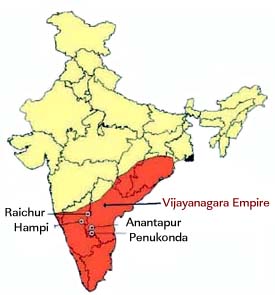
  • The Vijayanagara Empire, an important South Indian empire was founded by Harihara Raya I and his brother Bukka Raya I. The capital of the empire was Vijayanagara, present days Hampi in Karnataka. The empire ruled from 1336 AD to 1646 AD although the power of the empire declined after the Battle of Talikota in 1565 AD.
  • Vijayanagara Empire was ruled by mainly four important dynasties. They were
  • Sangama Dynasty:It was the first dynasty of Vijayanagara Empire and Harihara Raya I( 1336-1356 AD) was the first ruler of the dynasty. Some of the rulers of the dynasty were: Bukka Raya, Virupaksha Raya, Deva Raya, Ramachandra Raya, Mallikarjuna Raya and Praudha Raya.
  • Saluva Dynasty: It was the first dynasty of Vijayanagara Empire andNarasimhadeva Raya (1485 AD to 1491 AD) first ruler of Saluva Dynasty of Vijayanagara Empire. He was succeeded by his son Thimma Bhupala. Narasimha Raya II was the last ruler of Saluva Dynasty succeeded his father Thimma Bhupala.

  • Tuluva Dynasty: It was the third dynasty of Vijayanagara Empire. The rulers of Tuluva Dynasty were: Narasa Nayaka, Viranarasimha Raya, KrishnadevaRaya, Achyutadeva Raya and Sadasiva Raya. Krishnadeva raya was a very powerful ruler of Vijayanagara Empire. It is considered that during his reign the empire reached its zenith. He ruled the empire from 1509 AD to 1529 AD.


  • Aravidu Dynasty: The fourth and last dynasty of Vijayanagara Empire was Aravidu Dynasty. After the Battle of Talikota the empire started to decline and Muslim states of Bijapur became prominent.


  • Political History:


  • Vijayanagar was founded in 1336 by Harihara and Bukka of the Sangama dynasty. They were originally served under the Kakatiya rulers of Warangal. Then they went to Kampili where they were imprisoned and converted to Islam. Later, they returned to the Hindu fold at the initiative of the saint Vidyaranya. They also proclaimed their independence and founded a new city on the south bank of the Tungabhadra river. It was called Vijayanagar meaning city of victory.


  • The decline of the Hoysala kingdom enabled Harihara and Bukka to expand their newly founded kingdom. By 1346, they brought the whole of the Hoysala kingdom under their control. The struggle between Vijayanagar and Sultanate of Madurai lasted for about four decades. Kumarakampana’s expedition to Madurai was described in the Maduravijayam. He destroyed the Madurai Sultans and as a result, the Vijayanagar Empire comprised the whole of South India up to Rameswaram.


  • The conflict between Vijayanagar Empire and the Bahmani kingdom lasted for many years. The dispute over Raichur Doab, the region between the rivers Krishna and Tungabhadra and also over the fertile areas of Krishna-Godavari delta led to this long-drawn conflict. The greatest ruler of the Sangama dynasty was Deva Raya II. But he could not win any clear victory over the Bahmani Sultans. After his death, Sangama dynasty became weak. The next dynasty, Saluva dynasty founded by Saluva Narasimha reigned only for a brief period (1486-1509).


  • Administration: 


  • Vijayanagar was the first southern Indian state to have encompassed three major linguistic and cultural regions and to have established a high degree of political unity among them. The administration of the kingdom sporadically achieved a relatively high degree of centralization, although centrifugal tendencies regularly appeared. To the original five rajyas (provinces) held by the Sangama brothers, new ones were added as territories were acquired.


  • The administration under the Vijayanagar Empire was well organized. The king enjoyed absolute authority in executive, judicial and legislative matters. He was the highest court of appeal. The succession to the throne was on the principle of hereditary. Sometimes usurpation to the throne took place as Saluva Narasimha came to power by ending the Sangama dynasty. The king was assisted by a council of ministers in his day to day administration. The Empire was divided into different administrative units called Mandalams, Nadus, sthalas and finally into gramas. The governor of Mandalam was called Mandaleswara or Nayak. Vijayanagar rulers gave full powers to the local authorities in the administration.


  • Besides land revenue, tributes and gifts from vassals and feudal chiefs, customs collected at the ports, taxes on various professions were other sources of income to the government. Land revenue was fixed generally one sixth of the produce. The expenditure of the government includes personal expenses of king and the charities given by him and military expenditure. In the matter of justice, harsh punishments such as mutilation and throwing to elephants were followed.


  • The Vijayanagar army was well-organized and efficient. It consisted of the cavalry, infantry, artillery and elephants. High-breed horses were procured from foreign traders. The top-grade officers of the army were known as Nayaks or Poligars. They were granted land in lieu of their services. These lands were called amaram. Soldiers were usually paid in cash.


  • Social Life:


  • Allasani Peddanna in his Manucharitam refers the existence of four castes – Brahmins, Kshatriyas, Vaisyas and Sudras – in the Vijayanagar society. Foreign travelers left vivid accounts on the splendour of buildings and luxurious social life in the city of Vijayanagar. Silk and cotton clothes were mainly used for dress. Perfumes, flowers and ornaments were used by the people. Paes mentions of the beautiful houses of the rich and the large number of their household servants. Nicolo Conti refers to the prevalence of slavery. Dancing, music, wrestling, gambling and cock-fighting were some of the amusements. The Sangama rulers were chiefly Saivaites and Virupaksha was their family deity. But other dynasties were Vaishnavites. Srivaishnavism of Ramanuja was very popular. But all kings were tolerant towards other religions. Borbosa referred to the religious freedom enjoyed by everyone. Muslims were employed in the administration and they were freely allowed to build mosques and worship. A large number of temples were built during this period and numerous festivals were celebrated. The Epics and the Puranas were popular among the masses.


  • The position of women had not improved. However, some of them were learned. Gangadevi, wife of Kumarakampana authored the famous work Maduravijayam. Hannamma and Thirumalamma were famous poets of this period. According to Nuniz, a large number of women were employed in royal palaces as dancers, domestic servants and palanquin bearers. The attachment of dancing girls to temples was in practice. Paes refers to the flourishing devadasi  Polygamy was prevalent among the royal families. Sati was honoured and Nuniz gives a description of it.


  • Economic Condition:


  • According to the accounts of the foreign travelers, the Vijayanagar Empire was one of the wealthiest parts of the world at that time. Agriculture continued to be the chief occupation of the people. The Vijayanagar rulers provided a stimulus to its further growth by providing irrigation facilities. New tanks were built and dams were constructed across the rivers like Tunghabadra. Nuniz refers to the excavation of canals.


  • There were numerous industries and they were organized into guilds. Metal workers and other craftsmen flourished during this period. Diamond mines were located in Kurnool and Anantapur district. Vijayanagar was also a great centre of trade. The chief gold coin was the varaha but weights and measures varied from place to place. Inland, coastal and overseas trade led to the general prosperity. There were a number of seaports on the Malabar coast, the chief being Cannanore. Commercial contacts with Arabia, Persia, South Africa and Portugal on the west and with Burma, Malay peninsula and China on the east flourished. The chief items of exports were cotton and silk clothes, spices, rice, iron, saltpeter and sugar. The imports consisted of horses, pearls, copper, coral, mercury, China silk and velvet clothes. The art of shipbuilding had developed.


  • Cultural Contributions: 


The temple building activity further gained momentum during the Vijayanagar rule. The chief characteristics of the Vijayanagara architecture were the construction of tall Raya Gopurams or gateways and the Kalyanamandapam with carved pillars in the temple premises. The sculptures on the pillarwere carved with distinctive features. The horse was the most common animal found in these pillars. Large mandapams contain one hundred pillars as well as one thousand pillars in some big temples. These mandapams were used for seating the deity on festival occasions. Also, many Amman shrines were added to the already existing temples during this period.


  • The most important temples of the Vijayanagar style were found in the Hampi ruins or the city of Vijayanagar. Vittalaswamy and Hazara Ramaswamy temples were the best examples of this style.


  • The Varadharaja and Ekamparanatha temples at Kanchipuram stand as examples for the magnificence of the Vijayanagara style of temple architecture. The RayaGopurams at Thiruvannamalai and Chidambaram speak the glorious epoch of Vijayanagar. They were continued by the Nayak rulers in the later period. The metal images of Krishna Deva Raya and his queens at Tirupati are examples for casting of metal images. Music and dancing were also patronized by the rulers of Vijayanagar.


  • Different languages such as Sanskrit, Telugu, Kannada and Tamil flourished in the regions. There was a great development in Sanskrit and Telugu literature. The peak of literary achievement was reached during the reign of Krishna Deva Raya. He himself was a scholar in Sanskrit and Telugu. His famous court poet Allasani Peddanna was distinguished in Telugu literature. Thus the cultural contributions of the Vijayanagar rulers were many-sided and remarkable.

.


Decline of the Vijayanagara Empire: The Battle of Talikota (1565):

During his rule, Rama Raya interfered in the conflicts among the Deccan Sultanates, first, in alliance with one, and then with another. In the beginning he joined with Ahmednagar, Bidar and Golconda and fought with Bijapur. In 1558, he invaded Ahmednagar, joining with Ali Adil Shah of Bijapur and during this march, his army committed great outrages; they insulted the Muslim women, destructed Mosques and disrespected the holy Quran. This incensed the followers of Islam, even the allied troops of Bijapur. Meanwhile the Sultanates lost many of their dominions to Rama Raya. Ferishta tells us that Rama Raya daily continuing to encroach on the dominions of the Sultans, Ali Adil Shah resolved to curb his insolence and reduce his power by a league of the faithful against him; for which purpose he convened an assembly of his friends and confidential advisers. According to them the number of Rama’s forces was too vast, against which no single Muhammadan monarch could hope to contend with the smallest prospect of success. Therefore, the Sultans decided to unite to reduce the power of Rama Raya.


The political treaties and marriage agreements (Hussein Nizam Shah gave his daughter Chand Bibi in marriage to Ali Adil Shah and Huddeea Sultana, Ali’s sister, was married to Murtaza Shah, son of Hussein Nizam Shah) were drawn out, and mutually confirmed by the most solemn oaths.

The Battle of Talikotta was fought between Rama Raya and the combined armies of the four Deccan Sultans, Hussein Nizam Shah of Ahmednagar, Ibrahim Qutub Shah of Golconda, Ali Adil Shah of Bijapur and Ali Barid Shah of Bidar, on the banks of the river Krishna on 26 Jan 1565. Rama Raya entrusted his right wing to Tirumala, to oppose Qutb Shah, and his left wing to Venkatadry, against Ali Adil Shah, while Rama Raya, an old but energetic man in his seventy’s, himself commanded the center. Rama Raya was seated himself on a rich throne set with jewels, under a canopy of crimson velvet, embroidered with gold and adorned with fringes of pearls, caused his treasurer to place heaps of money around him, that he might confer rewards on such of his soldiers as merited the distinction; rich ornaments of gold and jewels were also placed before him for the same purpose.


Unfortunately, an elephant belonging to Nizam Shah, became wild and dashed towards him and he fell down from the palanquin. Before he could recover, he was bounded by ropes and taken to Nizam Shah and finally, he was beheaded. The Muslim army looted the city; people were slaughtered; temples and houses were burnt; the sacred Hindu idols were destroyed and the wealthy empire was plundered. The plunder was so great, that every private man in the allied army became rich in gold, jewels, tents, arms, horses, and slaves. The kingdom of Vijayanagara never recovered its ancient splendor!

Aravidu Dynasty (1565-1646): Although Vijayanagara was destroyed, Tirumala along with Sadashiva escaped to Penukonda where they tried to rebuild the empire. In 1568, Tirumala murdered Sadasiva, and seized the throne for himself (1568-1575). Tirumala was succeeded by his son Sri Ranga Raya (1575-1586) and later followed by his brother, Venkatapati Raya I (1586-1614) who shifted the capital from Penukonda to Chandragiri. During that time, the largest feudatories of the Vijayanagar empire; the Wodeyars of Mysore and the Nayakas of Ikkeri declared their independence. Venkatapati was succeeded by Sri Ranga Raya II in 1614 and later by Ramadeva (1617-1632). Venkata III (1632-1642) again shifted the capital to Vellore. Sri Ranga III (1642-1646) was the last ruler of the Vijayanagara empire.

Functioning under a Coalition Government

Coalition government is a cabinet of a parliamentary government in which several parties cooperate. Coalition governments are usually formed as no party can individually achieve a majority in the parliament. However, a coalition government may also be created in a time of national difficulty or crisis. If a coalition collapses, a confidence vote is held or a motion of no confidence is taken.

The 1967 elections also initiated the dual era of short-lived coalition govemments and politics of defection. However, the elections broke Congress’s monopoly of power in the states. Congress was replaced not by a single party in any of the states but by a multiplicity of parties and groups and independents. Coalition governments were formed in all opposition-ruled states except in Tamil Nadu. In Punjab, Bihar and U.P., opposition governments included Swatantra, Jan Sangh, BKD, Socialists and CPI. Though CPM did not join these governments, it, too, actively supported them.

Congress too formed coalition governments in some of the states where it had been reduced to a minority, allying with independents and breakaway groups from the opposition parties. Except the DMK government in Tamil Naau and the Swatantra-led government in Orissa, the coalition governments in all the other states, whether formed by Congress or the opposition, proved to be highly unstable and could not stay in power for long. All the coalition governments suffered from constant tensions and internal strains because of the heterogeneity of the partners. These governments would get formed, break up as a result of changing loyalties of MLAs and then are re-formed again.

Parties, including Congress, would topple existing governments, change partners and form new governments. In between governments, a state would sometimes undergo a period of President’s Rule or even mid-term polls, which seldom changed the pattern of seats in the assembly. Thus, from the 1967 general elections to the end of 1970, Bihar had seven governments, U.P. four, Haryana, Madhya Pradesh, Punjab and West Bengal three each and Kerala two governmental changes, with a total of eight spells of President’s Rule in the seven states.

The other important feature of the coalition governments of the period was the beginning of the politics of defection. Many of the governmental changes in the northern states were the result of defections or floor crossings by individual legislators, both party members and independents. Corrupt legislators indulged in horse-trading and freely changed sides, attracted mainly by lure of office or money. In Haryana, where the defection phenomenon was first initiated, defecting legislators began to be called Ay a Ram and Goya Ram (in-coming Ram and out-going Ram). Consequently, except in the case of the two Communist parties and Jan Sangh, party discipline tended to break down. Between 1967 and 1970, nearly 800 assembly members crossed the floor, and nearly 155 of them were rewarded with ministerial offices.

[jetpack_subscription_form title=”Subscribe to APPSC Notes” subscribe_text=”Never Miss any APPSC important update!” subscribe_button=”Sign Me Up” show_subscribers_total=”1″]