
 rawan239
Land reforms
- In rural India, land is the single most important productive asset owned by the people
Why are land reforms needed?
Rise of National Movement and Indian National Congress
Why did national movement arise?
- Indian nationalism rose to meet the challenges of foreign domination
- The British rule and its direct and indirect consequences provided the material and the moral and intellectual conditions for the development of a national movement in India.
- Clash of interest between the interests of the Indian people with British interests in India
- Increasingly, the British rule became the major cause of India’s economic backwardness
- Every class gradually discovered that their interests were suffering at the hands of the British
- Peasant: Govt took a large part of produce away as land revenue. Laws favoured the Zamindars
- Artisans: Foreign competition ruined the industry
- Workers: The government sided with the capitalists
- Intelligentsia: They found that the British policies were guided by the interests of British capitalists and were keeping the country economically backward. Politically, the British had no commitment of guiding India towards self-government.
- Indian capitalists: the growth of Indian industries was constrained by the unfavourable trade, tariff, taxation and transport policies of the government.
- Zamindars, landlords and princes were the only ones whose interests coincided with those of the British. Hence they remained loyal to them.
- Hence, it was the intrinsic nature of foreign imperialism and its harmful effect on the lives of the Indian people that led to the rise of the national movement. This movement could be called the national movement because it united people from different parts of the country as never before for a single cause.
What factors strengthened and facilitated the national movement?
- Administration and Economic Unification of the country
- Introduction of modern trade and industries on all-India scale had increasingly made India’s economic life a single whole and interlinked the economic fate of people living in different parts of the country.
- Introduction of railways, telegraph and unified postal system brought together different parts of the country and promoted contact among people like never before.
- This unification led to the emergence of the Indian nation
- Western Thought and Education
- A large number of Indians imbibed a modern rational, secular, democratic and nationalist political outlook
- They began to study, admire and emulate the contemporary nationalist movements of European nations
- The western education per se did not create the national movement. It only enabled the educated Indians to imbibe western thought and thus to assume the leadership of the national movement and to give it a democratic and modern direction
- Modern education created a certain uniformity and community of outlook and interests among the education Indians.
- Role of Press and Literature
- Large number of nationalist newspapers appeared in the second half of the 19th century
- They criticized the policies of the British government and put forth the Indian point of view
- National literature in form of essays, novels and poetry also played an important role. Bamkin Chandra, Tagore: Bengali; Bhartendu Harishchandra: Hindi; Lakshmikanth Bezbarua: Assamese; Vishnu Shastri Chiplunkar: Marathi; Subramanya Bharti: Tamil; Altaf Husain Hali: Urdu
- Rediscovery of India’s past
- The British had lowered the self confidence of the Indian through the propaganda that Indians are incapable of self-government
- Nationalist leaders referred to the cultural heritage of India to counter this propaganda. They referred to political achievements of rulers like Ashoka, Chandragupta Vikramaditya and Akbar.
- However, some nationalists went to the extent of glorifying the past uncritically. They emphasized on the achievements of ancient India and not medieval India. This encouraged the growth of communal sentiments.
- Racial arrogance of the rulers
- Englishmen adopted a tone of racial superiority in their dealings with the Indians
- Failure of justice whenever an Englishman was involved in a dispute with an Indian.
- Indians kept out of European clubs and often were not permitted to travel in same compartment as Englishmen
Rise of Indian National Congress
Predecessors of INC
- East India Association
- By Dadabhai Naoroji in 1866 in London
- To discuss the Indian question and to influence the British public men to discuss Indian welfare
- Branches of the association in prominent Indian cities
- Indian Association
- Surendranath Banerjee and Ananda Mohan Bose in 1876, Calcutta
- The aim of creating strong public opinion in the country on political questions and the unification of the Indian people on a common political programme
- Poona Sarvajanik Sabha
- Justice Ranade, 1870
- Madras Mahajan Sabha
- Viraraghavachari, Anand Charloo, G Subramanian Aiyer, 1884
- Bombay Presidency Association
- Pherozshah Mehta, K T Telang, Badruddin Tyabji, 1885
- These organizations were narrow in their scope and functioning. They dealt mostly with local questions and their membership were confined to a few people belonging to a single city or province
Indian National Congress
- Indian National Congress was founded on 28 December 1885 by 72 political workers. A O Hume was the first secretary and was instrumental in establishing the Congress
- First session in Bombay. President: W C Bonnerjee
- With the formation of INC, the Indian National Movement was launched in a small but organized manner
- The Congress itself was to serve not as a party but as a movement
- Congress was democratic. The delegates to INC were elected by different local organizations and groups
- Sovereignty of the people
- In 1890, Kadambini Ganguli, the first woman graduate of Calcutta University addressed the Congress session
- Safety Valve Theory
- The INC was started under the official direction, guidance and advice of Lord Dufferin, the Viceroy, to provide a safe, mild, peaceful and constitutional outlet or safety valve for the rising discontent among the masses, which was inevitably leading towards a popular and violent revolution.
Does the safety valve theory explain the formation of Congress?
- The safety valve theory is inadequate and misleading
- INC represented the urge of the Indian educated class to set up a national organization to work for their political and economic development
- A number of organizations, as mentioned above, had already been started by the Indians towards that end
- Hume’s presence in Congress was used to allay official suspicions
Why was there a need for an All-India organization?
- Vernacular Press Act, 1878
- Ilbert Bill (1883) which would allow Indian judges to try Europeans was opposed by the European community and was finally enacted in a highly compromised state in 1884.
- The Indians realized that they could not get the Ilbert bill passed because they were not united on all India level. Hence need for INC was felt.
- In order to give birth to the national movement
- Creation of national leadership was important
- Collective identification was created
Aims of INC
- Promotion of friendly relations between nationalist political workers from different parts of the country
- Development and consolidation of the feeling of national unity irrespective of caste, religion or province
- Formulation of popular demands and their presentation before the government
- Training and organization of public opinion in the country
- The first major objective of the Indian national movement was to promote weld Indians into a nation, to create an Indian identity
- Fuller development and consolidation of sentiments of national unity
- Efforts for unity: In an effort to reach all regions, it was decided to rotate the congress session among different parts of the country. The President was to belong to a region other than where the congress session was being held.
- To reach out to the followers of all religions and to remove the fears of the minorities, a rule was made at the 1888 session that no resolution was to be passed to which an overwhelming majority of Hindu or Muslim delegates objected.
- In 1889, a minority clause was adopted in the resolution demanding reform of legislative councils. According to the clause, wherever Parsis, Christians, Muslims or Hindus were a minority their number elected to the councils would not be less than their proportion in the population.
- To build a secular nation, the congress itself had to be intensely secular
- The second major objective of the early congress was to create a common political platform or programme around which political workers in different parts of the country could gather and conduct their political activities.
- Due to its focus solely on political issues congress did not take up the question of social reform.
- Since this form of political participation was new to India, the arousal, training, organization and consolidation of public opinion was seen as a major task by the congress leaders.
- Going beyond the redressal of immediate grievances and organize sustained political activity.
E Governance
E Governance
The “e” in e-Governance stands for ‘electronic’. Thus, e-Governance is basically associated with carrying out the functions and achieving the results of governance through the utilization of ICT (Information and Communications Technology), So it is the application of information and communication technology (ICT) for delivering government services, exchange of information, communication transactions, integration of various stand-alone systems and services between government-to-customer (G2C), government-to-business (G2B), government-to-government (G2G) as well as back office processes and interactions within the entire government framework.Through e-governance, government services will be made available to citizens in a convenient, efficient and transparent manner. The three main target groups that can be distinguished in governance concepts are government, citizens and businesses/interest groups.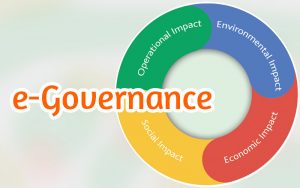
Types of Government Interaction in e-governance.
- G2G: Government to Government
- G2C:Government to Citizen
- G2B: Government to Business
- G2E:Government to Employee
- G2G (Government to Government): When the exchange of information and services is within the periphery of the government, is termed as G2G interaction. This can be both horizontal, i.e. among various government entities and vertical, i.e. between national, state and local government entities and within different levels of the entity.
- G2C (Government to Citizen): The interaction amidst the government and general public is G2C interaction. Here an interface is set up between government and citizens, which enables citizens to get access to wide variety of public services. The citizens has the freedom to share their views and grievances on government policies anytime, anywhere.
- G2B (Government to Business): In this case, the e-governance helps the business class to interact with the government seamlessly. It aims at eliminating red-tapism, saving time, cost and establish transparency in the business environment, while interacting with government.
- G2E (Government to Employees): The government of any country is the biggest employer and so it also deals with employees on a regular basis, as other employers do. ICT helps in making the interaction between government and employees fast and efficient, along with raising their level of satisfaction by providing perquisites and add-on benefits.
E-governance can only be possible if the government is ready for it. It is not a one day task, and so the government has to make plans and implement them before switching to it. Some of the measures include Investment in telecommunication infrastructure, budget resources, ensure security, monitor assessment, internet connectivity speed, promote awareness among public regarding the importance, support from all government departments and so forth.
Benefits of E-governance
- Reduced corruption
- High transparency
- Increased convenience
- Growth in GDP
- Direct participation of constituents
- Reduction in overall cost.
- Expanded reach of government
Through e-governance, the government plans to raise the coverage and quality of information and services provided to the general public, by the use of ICT in an easy, economical and effective manner. The process is extremely complicated which requires, the proper arrangement of hardware, software, networking and indeed re-engineering of all the processes to facilitate better delivery of services.
E Governance in India
e-Governance in India has transformed to promote inclusive growth that covers electronic services, products, devices and job opportunities. An initiative driving this growth is the Digital India. The Digital India programme is a flagship programme of the Government of India with a vision to transform India into a digitally empowered society and knowledge economy.
National E-governance Plan
The National e-Governance Plan (NeGP) has been formulated by the Department of Electronics and Information Technology (DEITY) and Department of Administrative Reforms and Public Grievances (DARPG) in 2006.
The NeGP aims at improving delivery of Government services to citizens and businesses with the following vision: “Make all Government services accessible to the common man in his locality, through common service delivery outlets and ensure efficiency, transparency & reliability of such services at affordable costs to realise the basic needs of the common man.”
Recent initiatives and Mission mode Projects
§ UID
The unique identification project was conceived as an initiative that would provide identification for each resident across the country and would be used primarily as the basis for efficient delivery of welfare services. It would also act as a tool for effective monitoring of various programs and schemes of the government.
- e-Governance in Municipalities
It is a unique initiative of the Government of India conceptualized under the umbrella of the overall National e-Governance Plan (NeGP) and the Jawaharlal Nehru National Urban Renewal Mission (Jnnurm) aimed at improving operational efficiencies within Urban Local Bodies (ULBs).
§ Crime and Criminal Tracking Network & Systems
Crime and Criminal Tracking Network & Systems (CCTNS) MMP aims at creating a comprehensive and integrated system for enhancing the efficiency and effective policing at all levels and especially at the Police Station level through adoption of principles of e-Governance, and creation of a nationwide networked infrastructure for evolution of IT-enabled state-of-the-art tracking system.
§ Public Distribution System
Computerization of the PDS is envisaged as an end-to-end project covering key functional areas such as supply chain management including allocation and utilization reporting, storage and movement of food grains, grievance redressal and transparency portal, digitization of beneficiary database, Fair Price Shop automation, etc.
§ Health
ICT for programme management has been undertaken by the Ministry of Health & Family Welfare in the Mother and Child Tracking System (MCTS) programme and the Ministry envisages a more comprehensive use of ICT including for Hospital Information Systems, supply chain management for drugs and vaccines, providing ICT tools to ASHA and ANM workers.
§ e-procurement
Ministry of Commerce & Industry (Department of Commerce) has been nominated as the Nodal Ministry for implementation of e-Government Procurement (e-GP) Mission Mode Projects (MMP).
§ e-Courts
The e-Court Mission Mode Project was conceptualized with a vision to transform the Indian judiciary by making use of technology. The project had been developed, following the report submitted by the e-Committee under Supreme Court on national policy & action plan on implementation of information communication tools in Indian judiciary.
§ e-Biz
The e-Biz Mission Mode Project, being executed by Department of Industrial Policy and Promotion (DIPP), Ministry of Commerce and Industry, Government of India, was conceptualized with the vision
- Direct Cash transfer
To facilitate disbursements of Government entitlements like NREGA, Social Security pension, Handicapped Old Age Pension etc. of any Central or State Government bodies, using Aadhaar and authentication thereof as supported by UIDAI.
- M Governance
M-Governance is not a replacement for e-Governance, rather it complements e- Governance. M-Governance, is the use of mobile or wireless to improve Governance service and information “anytime, anywhere”.
- Mobile Seva
It aims to provide government services to the people through mobile phones and tablets. It has been developed as the core infrastructure for enabling the availability of public services through mobile devices.
The Working Class Movements
- There were some working class movements in second half of 19th century. However, they were impulsive and not very well organized.
- The early nationalists had a lukewarm attitude towards the question of workers. This war because initially Congress wanted to focus on issues which were of common concern to all the people of India.
- There was a difference in attitude of the nationalists towards workers in indigenous and European enterprises.
- The most important feature of the labour movement during the Swadeshi days was the shift from agitation and struggles on purely economic questions to the involvement of the worker with the wider political issues of the day.
- The All India Trade Union Congress (AITUC) was founded in 1920.
- IN 1918 Gandhi founded the Ahmedabad Textile Labour Association.
- The AITUC in November 1927 took a decision to boycott the Simon Commission and many workers participated in the massive Simon boycott demonstrations.
- Alarmed by worker’s movement, the government enacted repressive laws like the Public Safety Act and Trade Disputes Acts and arrested the entire radical leadership of the labour movement and launched the Meerut Conspiracy Case against them.
- The labour movement suffered a major setback partially due to this government offensive and partially due to a shift in stance of the communist led wing of the movement.
- From the end of 1928, the communists stopped aligning them with the national movement.
- Communists got isolated within the AITUC and were thrown out in the split of 1931.
- BY 1934, the communists re-entered the mainstream nationalist politics.
- The working class of Bombay held an anti-war strike on 2 October, 1939.
- With the Nazi attack on the Soviet Union in 1941, the communists changed their policy and asked the people to support the allied forces instead of holding anti-war strikes.
- The communists dissociated themselves from the Quit India movement launched in 1942.
- The last years of colonial rule also saw a remarkably sharp increase in strikes on economic issues all over the country – the all India strike of the post and telegraph department employees being the most well known among them.
Natural and Power resources of Arunachal Pradesh
Natural and Power resources of Arunachal Pradesh
Arunachal Pradesh has an area of 83,743 sq kms. It is the largest state in the North Eastern region sharing its international boundaries with Bhutan in the west , China in the North and Myanmar in the East. It also shares border with state of Assam and Nagaland in the southern and south eastern area. Total forest cover is about 82% and the state has numerous turbulent streams , fast flowing rivers , deep gorges , lofty mountains , snow clad peaks and rich biodiversity.
Total generating capacity of the state was only 32 MW hydro and 28.63 MW diesel till now, which has increased substantially with the completion of 405 MW Ranganadi hydropower project. 600MW Kameng hydro power project is under construction and these projects will provide electricity not only to the Arunachal Pradesh and other states in the north eastern region but also to the power starved regions of the country.
The per capita consumption of Arunachal Pradesh is below 100 Kwh as compared to the national average of 373Kwh. The state plans to harness its enormous potential from natural resources like forests and hydro power and exploit its mineral wealth to usher in the era of economic development and raise the capita electricity consumption to the 500 Kwh.
Power Installations In 2016-17
In June 2016, the state accounted for an installed capacity of power generation of 55.41 MW from thermal power plants out of which 43.06 MW is contributed by gas power plants and 12.35 MW from coal power plants.
For the installation of 40,000 MW grid connected solar rooftop system in the country by 2022, the target allocated for the state is 50 MW.
Use of Conventional resources and its issues
Conventional resources of energy are rapidly depleting and there is no formation of conventional sources of energies in near future. So there is need to divert our attention to renewable energy resources. The main concern over the rapid consumption of Fossil Fuels is they are depleting at fast pace. And there should be use of renewable resources to meet the growing demands of utilization of non-renewable products
In order to preserve the energy resources through proper utilization, the power developers have to create awareness among the people about the use of renewable resources as non-renewable resources declining at a rapid rate due to increasing demands of its use in global market of energy conservation and make it a culture in the long run to be a efficient state. The power is the most important contributing factor of a developed state so to be efficient there should be exploration of all possible avenues to produce power.
Prospects on involvement of private sector in Hydro-Power generation is very benefitting. There is need for energy conservation and its efficiency. There is need to look for Power renewable energy, power trading, T&D loss reduction and technologies and equipments for effective energy generation.
The reserves of coal, oil and natural gas are limited and they do not regenerate. Hence such energies could be used only as long as they last and their emissions cannot be absorbed by nature. Consequently, none of these energy sources can satisfy both sustainability criteria. Therefore, the sustainability criteria are best satisfied by solar, wind, wave and most hydro-power options. The state will produce adequate energy in all ways and means that is safe and good for the state and its population.
Renewable energy in the state
The government has launched the programme for promoting power generation from renewable sources since the last 25 years. In India, the cumulative power generation from these sources is only around 11,272.13 MW and in State , Power generation from renewable resources is very less. Small hydro-power projects generating up to 25 MW power are also categorized as power renewable sources of energy.
However there are socio socio-economic problems associated with small hydro projects at place where it has caused hydro-projects blockade or diversion in downstream water affecting farming operations and causing drinking water availability problems in villages. India is also lagging behind in power generation from biomass, bagasse and waste despite its high potential.
Technology improvement for Renewable Energy
Technological improvements, better quality control, standardization and increased number of suppliers/ manufacturers/vendors in technologies such as wind manufacturers/vendors turbines, biomass cogeneration and hydro power, biomass gasification, small and micro micro-hydro, bio-diesel and solar photovoltaic are also aiding the growth of renewable energy.
Efficiency in energy utilization needs to be a continuous activity as there is huge continuous un productive energy utilization has seen. The world is moving towards a sustainable energy future with an emphasis on energy efficiency and use of renewable energy sources.
The North East has abundant renewable energy resources but their utilization has not been adequate. Apart from small hydel power projects, biomass holds a lot of scope in the region. Effective utilization of renewable energy could be of immense benefit in electrification of remote villages. The 11th Plan targeted utilization of renewable energy to the tune of 3,500 MW with a capacity addition of another 3,200MW. The private sector participation is very much encouraging in this regard. Continued growth of Indian economy will depend on large scale investments in its large-scale energy sector.
Central and State Governments should also address these issues for faster implementation of projects. Further, any development in the generation and objects transmission / sub-transmission infrastructure can only be sustained through transmission .Continuous cash-flow from end consumers, adequate focus needs to be on strengthening of the distribution sector through administrative and management sector reforms. the Central Government sponsored schemes such as the R-APDRP, and development of the human resources through appropriately designed training and development programs.
The state is sparsely populated and the wide dispersion in population makes the centralized generation and long T&D network a costly option. This explains the presence of distributed generation, having installed capacities of several KW only which cater for the local areas. The Arunachal Pradesh Electricity Department, a vertically integrated entity, is vertically-integrated responsible for generation, transmission and distribution of power in the State.
Although the state has a huge hydro potential to the order of 55,000 MW, it is mostly unexplored .The State’s own installed capacity is only 61 MW and is primarily dependent on primarily purchase of power from CPSUs (share of 119 MW). Peak demand of the state stood at130 MW in 2008-09 and peak demand and energy deficit stand at 39.2% and 36.4% respectively which are way above the national average figures.
The best way of contributing to the nation is to tap the hydro potentials in Arunachal Pradesh, which can meet the nation’s one one-third power requirements. Of the projected 60,000 MW of power potentials in the State, only 4 5% has so far been exploited. 4-5%Highlighting the vast potentials for renewable energy in North Eastern states
The dams are constructed using best of scientific technologies to maximize power production and minimize the hypothetical negative impact.
Mega Power Policy and Small Hydro Power Policy
The Government of Arunachal Pradesh has formulated Mega Power Policy and Small Hydropower Policy for project under 25 MW under Build, Own, and Operate and Transfer (BOOT) model. Projects are classified according to their size and the project identification, allocation and various statutory clearances are detailed in the policy. various. The private sector companies will have the option to execute hydro projects on Build, Own, Operate (BOO) or Build, Own, Transfer (BOT). The land required for construction of the project shall be acquired and leased to the developer against payment of land.
Objective is to formulate effective policy, proper technology delivery and besides capacity building for realizing the potential of the renewable energy sector.
The State has got abundant renewable energy resources and made a strong pitch for improving power generating capacities. Power-generating through improved technologies so as to meet the future power requirements of the country. Around 15 per cent of energy is being lost in distribution and transmission system, besides the unauthorized tapping of power
Solar Energy
India has abundant solar insolation and state is also have potential for solar energy. There is also need to emphasized on tapping the solar energy to meet the electricity needs of people of border areas in the state.
Focus is on tapping the resources for renewable energy and eradicate hurdles in tapping them. There is need to provide solar power in border areas of the state as it has vast potentials for renewable energy in North Eastern states.
Bio diversity in the state
There is need to conserve power and bio diversity as well. Bio-diversity in Arunachal Pradesh with 82per cent forest cover will put all efforts in saving its natural bio- biodiversity and at the same time will march forward with other states in terms of development by becoming energy efficient.
To protect the bio diversity, the government will soon eliminate the jhum cultivation and introduce tea and rubber cultivation. It will help in maintaining the economic balance and conserve bio diversity.
Efforts are being done in saving its natural bio diversity and at the same time co operate with other states in conserving bio diversity. Efforts are also done in terms of development by becoming energy efficient by producing adequate energy in all ways and means that is safe and good for the state and its population.
Wind Energy
Emphasizing the need of enhancing renewable energy wind power could be transform into effective energy in the state. India now ranks as a “wind superpower” with an installed wind power capacity of 1167 MW and about 5 billion units of electricity have been fed to the national grid so far.
In the state, around 15 per cent of energy has been lost while distributing power in various states. State has been focusing on minute details on the energy efficiency and conservation and renewable energy.
Biogas based Power Generation Programme (BPGP)
Biogas based power units can be a reliable decentralized power generation option in the country. In order to promote this route of power generation, specifically in the small capacity range (3 kW to 250 kW), based on the availability of large quantity of animal wastes and wastes from forestry, rural based industries (agro/food processing), kitchen wastes, etc; a number of projects of different capacities and applications will be taken up for refining the technical know-how, developing manpower and necessary infrastructure, establishing a proper arrangement of operation & maintenance and large scale dissemination. Various small bio gas power generations has been installed in the state.
Effective Policy for future generations
Sustainable energy is the provision of energy that meets the needs without compromising the ability of future generations to meet their needs. Technologies that promote sustainable energy include renewable energy sources, such as energy from hydroelectricity, solar energy, wind energy, wave power, bio gas, tidal power and also technologies ,designed to improve energy efficiency needs to be enhanced. The reserves of coal, oil and reserves natural gas are limited and they do not regenerate. Hence, such energies could be used only as long as they last and their emissions cannot be absorbed by nature. Consequently, none of the energy sources can satisfy both sustainability criteria. Therefore, the sustainability criteria are best satisfied by solar, wind, wave and most hydropower options.
Other options help to meet the sustainability goals were energy savings and increase energy efficiency.
Human Resource and Community Development
Human resource development includes development at various levels, including community. Community development requires HRD efforts, such as training and organization development. Community development is an alternative route to educating and training citizens of a community. Community settings, especially in developing countries, require that HRD practitioners take into account many factors, such as cultural variables, beliefs, traditions, and gender roles before bringing about change. Practicing HRD in a community setting requires a holistic approach to development. By its nature community development is multidisciplinary and, thus, using theories with a narrow focus to understand community development is inappropriate
Community development is a process where community members come together to take collective action and generate solutions to common problems. Community wellbeing (economic, social, environmental and cultural) often evolves from this type of collective action being taken at a grassroots level. Community development ranges from small initiatives within a small group to large initiatives that involve the broader community.
Effective community development should be:
- a long-term endeavour
- well-planned
- inclusive and equitable
- holistic and integrated into the bigger picture
- initiated and supported by community members
- of benefit to the community
- grounded in experience that leads to best practices
The Community Development Programme of India
The Community Development Programme has been the biggest rural reconstruction scheme undertaken by the government of free India. It has been variously described as the magnacarta of hope and happiness for two-thirds of India’s population, the testament of emancipation, the declaration of war on poverty, ignorance, squalor and disease under which millions have been groaning etc.
The Community Development Programme of the present form is, in the main, an American concept. It is, in a way, the culmination of the economics of rural reconstruction as learnt and developed in the United States with its practical usefulness justified under the Indian conditions.
The Community Development Programme is broadly divided into three phases. They are- (a) the National Extension Phase, (b) the Intensive Community Development Project Phase and (c) the Post-Intensive Development Phase.
In the first phase, the areas selected are subjected to the method of providing services on the ordinary rural development pattern with a lesser governmental expenditure. In the intensive phase, the blocks selected are subjected to more composite and more intensive development schemes with larger governmental expenditure.
In the post-intensive phase, it is presumed that the basis for self-perpetuation of the process initiated during the earlier phases has been created and the need for special government expenses reduced. Slowly the areas are left in the charge of the departments for the development.
An elaborate organization has been created to implement Community Development Projects; it is known as the Community Project Administration. Originally functioning under the Planning Commission, it is now under the charge of the newly created Ministry of Community Development.
The entire administration is composed of four major types- the central administration, the state administration, the district organization and the project administration. The power and the control flow from top to bottom making it a hierarchic bureaucratic organization.
Scope:
Needless to say that the Community Development Programme is a universal phenomenon practised both in developed and developing countries. But, the programme assumes vital significance in developing countries because of their low-level of development in various segments of social life.
Owing to its wider applicability in multifaceted fields of operation, it is not practically feasible to evolve a theoretical framework of the scope of Community Development Programme. However, for the sake of convenience, the field of Community Development Programme can broadly be divided into the following items.
1. Agricultural and allied fields:
Under this category activities regarding following items are included, (a) reutilisation of virgin and waste lands, (b) repairing of old wells, digging new wells and provision of major/minor irrigation facilities, (c) adoption of qualitative high-yielding seeds, manures, fertilizers, use of tractors etc., (d) provision of credit facilities for the development of animal husbandry, poultry farming, fishery, soil conservation etc. and (e) growth of vegetables and plants etc.
2. Organisation:
Organisation of ‘co-operative service societies’, multi-purpose cooperative societies, ‘marketing co-operatives’ and other types of people’s institutions.
3. Education:
Attaching importance to primary education, adult education and social education with the aim of expanding the mental horizon of the ruralites.
4. Employment:
For solving the problem of rural unemployment, attempts have been made for the setting up of small scale and cottage industries.
5. Health Services:
Provision for mobile, permanent dispensaries, arrangements for maternal care, medical aid during pregnancy, midwife service, child care etc.
6. Communication:
Repair of old roads, construction of new roads and arrangement for transportation and communication facilities.
7. Vocational training:
Imparting vocational training in the field of tailoring, embroidery, carpentry etc.
8. Supply of drinking water:
Attempting to provide safe drinking water by repairing old wells or constructing new ones.
9. Social welfare:
Social welfare activities include rehabilitation of old, disabled and destitute, provision for better housing, organisation of sports, promotion of cultural activities etc.
The Preamble
The Constitution of India begins with a Preamble which describes the nature of the Indian State and the objectives it is committed to secure. K.M. Munshi describes the Preamble as the political horoscope of the constitution. Thakur Dass Bhargawa says Preamble is the most precious part and the soul of the constitution.
The Preamble reads:
We, the People of India having solemnly resolved to constitute India into a Sovereign, Socialist, Secular, Democratic, Republic and to secure to all its citizens;
Justice, social, economic, political;
Liberty of thought, expression, belief, faith and worship;
Equality of status and opportunity; and to promote among them all;
Fraternity, assuring the dignity of the individual and the unity and integrity of the nation ;
In our Constituent Assembly this, twenty sixth day of November 1949 do hereby Adopt, Enact and Give to ourselves this Constitution.
The words ‘Socialist ‘Secular” and ‘Integrity were initially not there in the Preamble. These were added by the 42nd Amendment (1976) of the Constitution.
Preamble: Features:
I. The Source of Authority:
Popular Sovereignty:
The Preamble categorically accepts the principle of Popular Sovereignty. It begins with the words: ‘We the people of India’. These words testify to the fact that the people of India are’ the ultimate source of all authority. The Government derives its power from them.
II. Nature of State:
The Preamble describes five cardinal features of the Indian state:
(1) India is a Sovereign State:
The Preamble proclaims that India is a sovereign state. Such a proclamation denotes the end of rule over India. It testifies to the fact that India is no longer a dependency or colony or possession of British Crown. As a sovereign independent state, India is free both internally and externally to take her own decisions and implement these for her people and territories.
(2) India is a Socialist State:
In 1976, the Preamble was amended to include the word ‘Socialism’. It is now regarded as a prime feature of the State. It reflects the fact that India is committed to secure social, economic and political justice for all its people. India stands for ending all forms of exploitation as well as for securing equitable distribution of income, resources and wealth. This has to be secured by peaceful, constitutional and democratic means. The term ‘India is a Socialist state’ really means, ‘India is a democratic socialist state.’
(3) India is a Secular State:
By the 42nd Amendment, the term ‘Secular’ was incorporated in the Preamble. Its inclusion simply made the secular nature of the Indian Constitution more explicit. As a state India gives special status to no religion. There is no such thing as a state religion of India. India guarantees equal freedom to all religions. All religions enjoy equality of status and respect.
(4) India is a Democratic State:
The Preamble declares India to be a Democratic State. The Constitution of India provides for a democratic system. The authority of the government rests upon the sovereignty of the people. The people enjoy equal political rights. The people freely participate in the democratic process of self rule.
They elect their government. For all its acts, the government is responsible before the people. The people can change their government through elections. The government enjoys limited powers. It always acts under the Constitution which represents the supreme will of the people.
(5) India is a Republic:
The Preamble declares India to be a Republic. Negatively, this means that India is not ruled by a monarch or a nominated head of state. Positively, it means that India has an elected head of state who wields power for a fixed term. President of India is the elected sovereign head of the state. He holds a tenure of 5 years. Any Indian citizen can get elected as the President of India.
III. Four Objectives of the Indian State:
The Preamble lists four cardinal objectives which are to be “secured by the state for all its citizens”.
These are:
(1) Justice:
India seeks to secure social, economic and political justice for its people.
(i) Social Justice:
Social Justice means the absence of socially privileged classes in the society and no discrimination against any citizen on grounds of caste, creed, colour, religion, sex or place of birth. India stands for eliminating all forms of exploitations from the society.
(ii) Economic Justice:
Economic Justice means no discrimination between man and man on the basis of income, wealth and economic status. It stands for equitable distribution of wealth, economic equality, end of monopolistic control over means of production and distribution, decentralisation of economic resources, and securing of adequate opportunities to all for earning their livelihoods.
(iii) Political Justice:
Political Justice means equal, free and fair opportunities to the people for participation in the political process. It stands for the grant of equal political rights to all the people without any discrimination. The Constitution of India provides for a liberal democracy in which all the people have the right and freedom to participate.
(2) Liberty:
The Preamble declares liberty to be the second cardinal objective to be secured. It includes liberty of thought, expression, belief, faith and worship. The grant of Fundamental Rights (Part III) including the right to freedom is designed to secure this objective. Liberty of faith and worship is designed to strengthen the spirit of secularism.
(3) Equality:
The Preamble declares Equality as the third objective of the Constitution. Equality means two basic things:
(i) Equality of status i.e. natural equality of all persons as equal and free citizens of India enjoying equality before law.
(ii) Equality of opportunity i.e. adequate opportunities for all to develop. For securing the equality of status and opportunity, the Constitution of India grants and guarantees the fundamental Right to Equality.
(4) Fraternity:
Promotion of Fraternity among the people is the fourth objective is to promote Fraternity among all the people. Fraternity means the inculcation of a strong feeling of spiritual and psychological unity among the people. It is designed to secure dignity of the individual and unity and integrity of the nation.
IV. Date of Adoption and Enactment:
In its final paragraph, the Preamble specifies the important historical fact that the Constitution was adopted on 26 November, 1949. It was on this day that the Constitution received the signatures of the President of the Constituent Assembly and was declared passed.
V. Self-made Constitution:
The Constitution of India is an adopted, enacted and self-made constitution. It was adopted and enacted by the Constituent Assembly acting as the elected representative body of the people of India. The Preamble states the philosophical foundations of the Constitution India and enumerates its objectives.
It constitutes a Key for the interpretation of the Constitution. It is a part of the Basic Structure of the Constitution. Through, it’s Preamble, the Constitution a commits itself to Democracy, Republicanism, Socialism, Secularism, Liberalism and Welfare State. The Preamble states the objectives which the Constitution is committed to secure for all the people of India.
Congress Sessions
| 1885 | W.C. Bannerjee | Bombay | ||
| 1886 | Dadabhai Naroji | Calcutta | ||
| 1887 | Badruddin Tyabji | Madras | ||
| 1888 | George Yule | Allahabad | ||
| 1889 | William Weederburn | Bombay | ||
| 1905 | G.K. Gokhale | Banaras – Issues like welcoming the prince of wales led to feud | ||
| 1906 | Dadabhai Naoroji | Calcutta – Approval of issues of swadesi & national education. | ||
| Dadabhai Naoroji was chosen as compromise president. He | ||||
| declared swaraj as the objective. | ||||
| 1907 | Rashbihari Bose | Surat – split | ||
| 1912 | R.N. Madholkar | Bankipur. Shortest session as the efforts to make Aga Khan | ||
| preside over proved futile. | ||||
| 1916 | Ambika Charan | Lucknow. | ||
| Mazumdar | ||||
| 1920 | Calcuttta. Approval of Non cooperation Movement | |||
| 1921 | Ahmedabad – intensify Non Copperation Movement. | |||
| 1924 | Mahatma Gandhi | Belgaun | ||
| 1928 | Motilal Nehru | Calcutta. Adopted the Nehru Report – Constitution. | ||
| 1929 | Jawahar Nehru | Lahore. The resolution demanding complete independence was | ||
| passed on the banks of river Ravi. | ||||
| 1930 | No session but Independence Day Pledge adopted on 26th January | |||
| 1938 | S.C. Bose | Haripura. | ||
| 1939 | S.C. Bose | Tripuri. Formed ‘Forward Bloc’. | ||
ARUNACHAL PRADESH : VEGETATION AND FORESTS
Bio-geographically Arunachal pradesh is situated in the Eastern Himalayan province, the richest biogeographical province of the Himalayan zone. The entire territory forms a complex hill system with varying elevations ranging from 50m in the foot-hills and gradually ascending to about 7000m, traversed throughout by a number of rivers and rivulets. Apart from large number of timber species, there are innumerable varieties and kinds of orchids, medicinal plants, ferns, bamboos, canes, wild relative of large number of our cultivated plants, and even plants of biological curiosities, such as parasites, saprophytes, etc. are found. Other important group of plants are Rhododendrons, Hedychiums and oaks etc.
Orchids form a dominant group of plants with their attractive and unique blooms. There are more than 600 species of orchids, 52 species of rhododendron, 18 species of hedychium, 16 species of oak, 18 species of canes, 45 species of bamboo in addition to large number of medicinal and aromatic plants.Arunachal Pradesh has many species of endangered, endemic, primitive, and relict flora, Magnolia Pterocarpa pterocarpa is one such primitive angiosperm, which occurs in the foot-hills. Some rare and endangered flora that occur in Arunachal Pradesh are: Amentotazus assamica in Lohit District . Rhododendron arunachalense found in Subansiri District, Rhododendron dalhousie, and Tetracentron sinense, occurring in Kameng District, Rhododendron santapaul recorded in Subansiri District.
Gomphogyne macrocarpa found in Tirap and Kameng Districts, Gymnocladus assamicus and Lithocarpus Kamengensis available in Kameng district. Rhynchoglossum lasulinum in kameng and Subansiri District. Dendrocalamus sahni in Subansiri District. Hypericum griffitthii in Kameng District, Coptis teeta of Dibang Valley Districts, etc. The State harbours about 52 species of of Rhododendrons, 18 species of Hedychium , 16 species of Qaks, 33 species of Coniters and a large number of fems and lichens.
About 500 species of orchids occur in Arunachal Pradesh. These include about 140 species of terrestrial orchids with 15 saprophytes and about 340 epiphytes found in the different forest types. The prominent species are: Cymbidium ansifolium , C, grandiflorum, Coelogyne corymbosa. Dendroblum aphylla, D. fimbriatum var occulatum, D. densiflorum, Calanthe masuca, Phaius flavus, Paphiopedilum. Tairriearum, venustum renanthera imschootiana, vanda coenulea , etc. Rhynchostylis refusa is the state flower of Arunachal pradesh.
Types of forests in Arunachal pradesh
Arunachal Pradesh is a treasure trove of nature. It is one of the maximum forest cover state of India, Sixty one percent of its geographical area comprises forests. The forests are spread over an elevation of 100 m. in the foothill regions to 7,000 m in the Himalayas . Such an ecological diversity has naturally resulted in varying forest types. The tropical forests at the foothills up to the height of 1,000 m are of the wet evergreen variety as well as the tropical evergreen variety and the riverine semi green variety. Then there are the sub tropical forests 1,000-2,000 m), the pine forests 1,000-2,000 m) and the temperate forests 2,000-3,000m). There are both the broad-leafed temperate forests as well as the conifer forests. The bamboo forests and grasslands have not been enlisted so far.
Tropical forests :These forests occur up to an elevation of 900 metres above MSL . They are persent in all the districts along the foothills . These forests can further be classified into two main types viz. tropical evergreen forests and tropical semi evergreen forests.
Subtropical forests : This type of forests occur in districts between altitudes 800m to 1900m. These are essentially evergreen and dense in nature. The trees attain large dimensions (25-40m high). The forests are rich in species diversity and dominated by Fagaceae members. Castaniopsis lidica, C. armata, Quercus lamellose, Q. griffithili, Q. spicata, Q. Semiserrata, Q. fenestrala, Michelia ,Ulmus lancifolium, Engelhardia spicata, Ficus spp. Acer oblongum, Schima wallichji, S.khasiana, etc. are the dominant tree species. Luxurious growth of climbers, orchids & ferns, occurs in these forests.
Pine forests: These forests extend both in the subtropical and temperate belt in between 1000 m to 1800 m elevation. These are generally met with in rain shadow area and are represented by three different sepecsies viz. Pinus roxburghii, P. wallichiana and P.merkusii. Sub Tropical Pine Forest is found in Rupa and Dirang valley of Kameng district and forms either pure stands or occasionally mixed with P. wallichiana, Quercus spp, Prunus sp. Etc. P. wallichiana is widely distributed in Rupa, Dirang valley (Kameng district), Hapoli ( Lower Subansiri district), Mechuka (West Siang district), Anini (Dibang valley district). and Melinja ( Lohit district). In Kameng, Siang and Lower Subansiri district it is found in nearly pure stands or less frequently mixed with P. roxburghii, Quercus spp. Lyonia sp. Etc. In Dibang valley they are found in association with Betula alnoides, Alnus nepalensis, Lyona ovalifolia, etc. In Lohit district it is less extensive and is associated with Tsuga dimosa, Pinus merkusii, occurs in Lohit district along the Lohit valley extending from Kharang (Hawal) to Dichu.
Temperate forests: Occur in all districts of Arunachal pradesh as a continuous belt and can be divided into two subtypes viz. Temperate broad leaved forests and Temperate conifer forests.
Alpine forests : This type of vegetation occurs on the peaks of higher hills above an altitude of 4000 m upto 5500m above timber line. For major part of the year, the area is covered by snow and plant activity is restricted to a few months when snow melts. Alpine Vegetaion As a rule there are no tall trees but dwarf branches and shrubs and mainly herbs with deep roots and cushioned leaves and branches. The profusion of bright coloured flowers which is purely seasonal for a brief period makes the area highly attractive. Plans like Rhododendron nivale., R. anthopogon, R. thomsonii, Sedum sp.., Festuca sp.., Rhodiola sp,.. Saxifraga sp. Saussaurea sp,. Arenaria sp,. Rheum sp. etc. form the major constituent of this peculiar vegetation.
Bamboo Forests and Grasslands : Bamboo trees are seen throughout Arunachal Pradesh. They grow in pure stands with less associated species. Bamboos appear in areas abandoned after shifting cultivation. Bamboos of Arunachal Pradesh are Bambusa tulda, Pseudostachyum polymorphum, Cephalostachyum that occur in higher elevation between 1000m-2000m. Grasslands are found in plains and at higher elevations. It is maintained through recurring annual fires at higher elevation and excessive grazing at lower elevations. In lower elevation Saccharum spontaneum, Neyraudia reynaudiana, Chrysopogon aciculatus are the common grasslands that are visible.
APPSCE Mains Exam
APPSCE Prelims Exam
Admit Card
Syllabus & Exam Pattern
Previous Year Papers
Eligibility Criteria
Results
Answer Key
Cut Off
Recommended Books
Exam Analysis
Posts under APPSC
Score Card
Apply Online
Selection Process
Exam Dates
Exam Highlights
Notifications
Vacancies
Exam Pattern
Prelims Syllabus
Mains Syllabus
Study Notes
Application Form
Expected Cut-Off
Salary & Benefits
Mock Tests
Preparation Tips
Study Plan
Combined Competitive Examination (APPSCCE)
Assistant Engineer (Civil)
Assistant Engineer (Electrical)
Junior Engineer (Civil)
Junior Engineer (Electrical/Mechanical/Electronics/Telecommunication/Computer Engineering)
Assistant Audit Officer (AAO)
Assistant Section Officer (ASO)
Senior Personal Assistant (SPA)
Research Officer (RO)
Law Officer cum Junior Draftsman
Assistant Conservator of Forest (ACF)
Range Forest Officer (RFO)
Horticulture Development Officer (HDO)
Agriculture Development Officer (ADO)
Veterinary Officer
General Duty Medical Officer (GDMO)
Junior Specialist (Allopathy/Dental)
Medical Physicist
Lady Medical Officer
Sub-Inspector (Civil/IRBN)
Sub-Inspector (Telecommunication & Radio Technician)
Assistant System Manager
Computer Programmer
Assistant Programmer
Assistant Director (Training)
Assistant Auditor
Section Officer (LDCE)
Field Investigator
Foreman (Department of Printing)
Principal (ITI)
Principal (Law College)
Lecturer (Government Polytechnic)
Lecturer (DIET)
Post Graduate Teacher (PGT)
Trained Graduate Teacher (TGT)
Teacher-cum-Librarian
Finance & Accounts Officer / Treasury Officer
Inspector (Legal Metrology & Consumer Affairs)
Assistant Engineer (Agri-Irrigation Department)
Assistant Director (Cottage Industries)
Language Officer (Assamese / Bodo / Bengali)